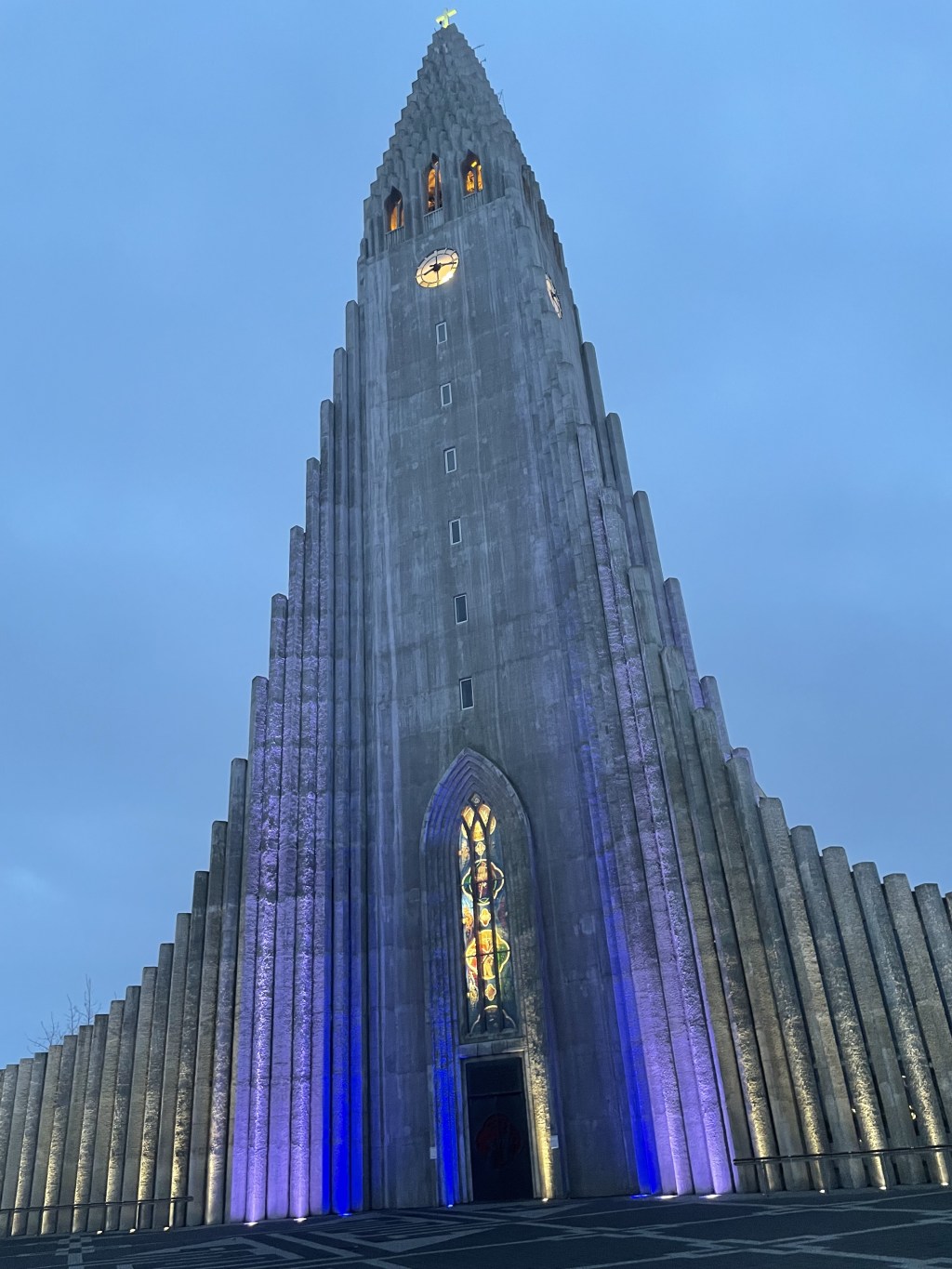
Iceland’s reputation of being a harsh landscape certainly holds true at first. Harsh winds and getting pelted by snow out the gates is quite the welcome to a foreign land. Initially, it felt that Iceland was almost was a different planet as it looks so different to anything seen in the North Eastern United States, which makes sense why they use its deserts to have trained astronauts sent to the moon and currently ones training for Mars. The area all around the airport was miles of ancient lava fields covered in unique basalt structures all over the landscape. The sprawling dark natural structures coupled with craters from lava flowing into water didn’t seem real. However, as we made our way into Reykjavík, the capital of Iceland, the Icelandic people’s culture really began to show. The church pictured, Hallgrímskirkja, is a massive building resembling the aforementioned basalt columns seen all over the island. The harsh nature of Iceland is exactly what makes its people prideful of the culture that has grown alongside them. To see flourishing after passing what looked liked a battlefield reflects the resourcefulness to manage to thrive in an unforgiving climate. This can be seen in the world’s largest geothermal power plant, Hellisheiði, that provides up to 303 MW of power for its citizens, industry, and uses the waste heat to warm homes and other applications. Furthermore, the waste products are disposed of in a way to prevent further pollution and assists in the hope for the plant’s carbon neutrality. Not only can their push for cleaner practices be seen, so too can their love of art. Statues are all over the city center denoting the tales of myth. The love for their mythological origin highlights this with statues of Norse tales/gods showing their original beliefs. Overall, this island may be smaller in population, but certainly has shown there is much more to it geologically and culturally.
- Comment
- Reblog
-
Subscribe
Subscribed
Already have a WordPress.com account? Log in now.
 Swanson School of Engineering