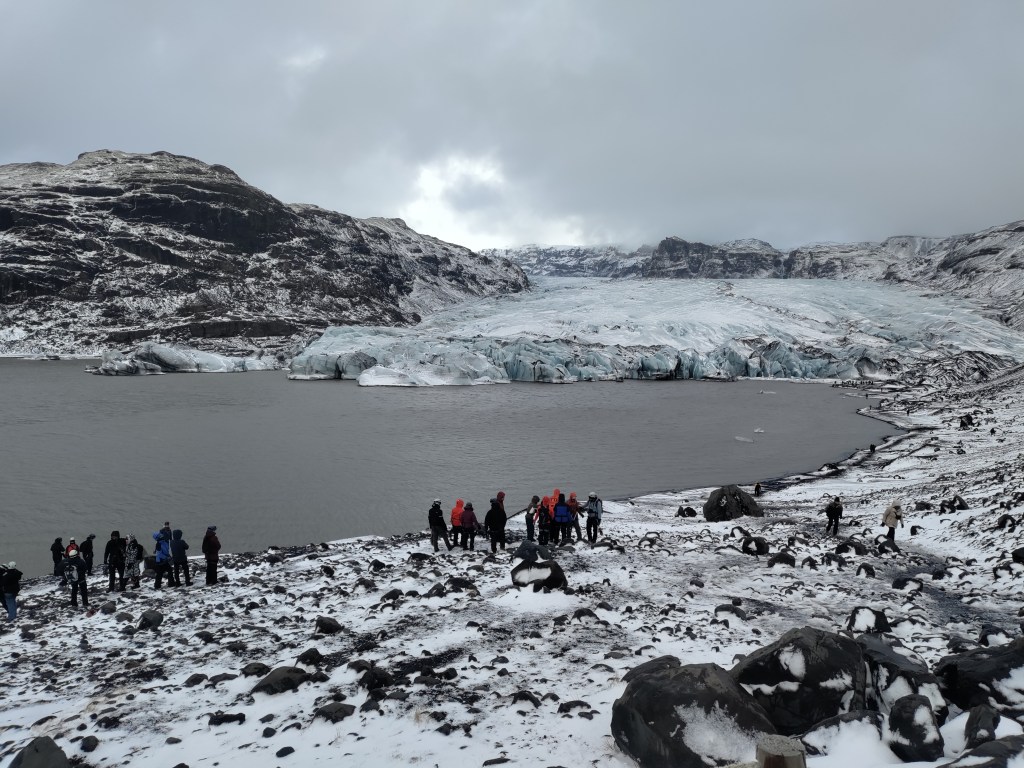
Today we visited Solheimajokull, a popular glacier to visit in the South of Iceland. From the parking lot, we started on a snowy, gravelly path along a lake that had been formed by meltwater from the glacier. After walking about 10 minutes in strong wind, the glacier appeared as we rounded the corner, its blueish-white mass crossing the width of the valley. It was a pretty impressive sight, and it was amazing to see something that could carve through solid rock and reshape the terrain in person. However, what was equally as impressive was how fast the glacier had retreated; just 30 years ago, the glacier had reached all the way to the parking lot we had started at, representing a rate of 1 km in the last decade. This retreat represents what is happening to glaciers all over Iceland; as the climate warms, the total ice volume has been decreasing. This is significant as hydroelectricity provides 70% of the country’s electricity, and glaciers feed many of the largest reservoir. Simply put, losing these glaciers would threaten electricity production in Iceland.
There are many solutions that have proposed; one is carbon capture, collecting carbon dioxide by sucking it out of the air. In fact, we passed one such facility on the first day of the trip. Mammoth and Orca, next to the Helleshedei geothermal power plant, are carbon capture facilities that can collect 36,000 tons of carbon every year. However world wide CO2 emissions are 35 billion tons per year, orders of magnitude larger than what the carbon capture facilities can handle. And few places have cheap, renewable geothermal energy like Iceland does. Clearly, carbon capture will not be sufficient to address climate change, and we need to reduce carbon emissions as well.
 Swanson School of Engineering