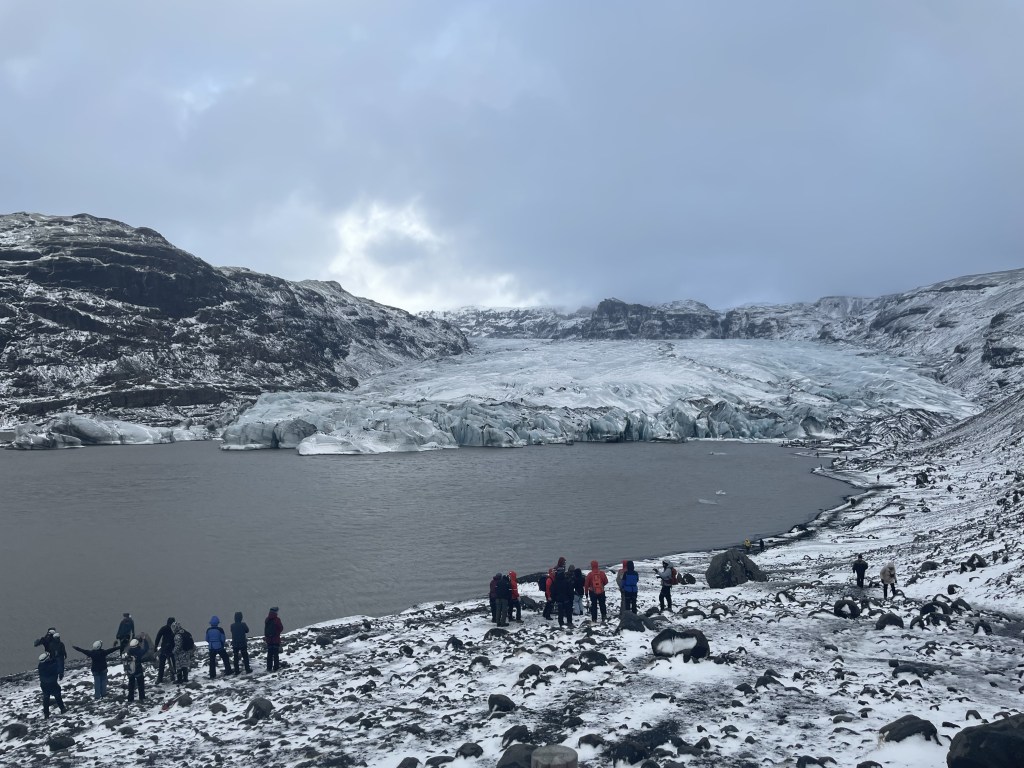
One of our adventures today focused on exploring the Sólheimajökull glacier and the surrounding area. The area we were walking along was a smaller section of the larger Mýrdalsjökull glacier that covers roughly 230 square miles and reachers a height of about 5000 feet at its highest point. The Sólheimajökull glacier has retreated up the valley over the course of years, carving a path and carrying soil and rock hundreds of yards. Each year the glacier creeps forwards and backwards, so the retreat up the valley is not the main concern for the glacier and surrounding community. The real issue is that the thickness of the glacier has been rapidly shrinking over time. The ice of the glacier forms as large quantities of snow land on the top and slowly the bottom layers become compressed by the weight of the snow above. This compressed snow turns more into a slush before turning to ice and giving the glacier and its standard appearance. The glacier is involved in a few key tasks. One of these is compressing the land it sits on, which stabilizes the sides of the valley it has carved over time. As it retreats, the sides of the valley can become unstable and have land slides. The most important feature is the glacier covers one of the largest volcanoes on the island, Katla. This helps prevent the eruption in the first place from the weight preventing it from being able to breach the surface and, in the case it did somehow erupt, either completely contain it or drastically reduce it. So the thickness of the glacier is crucial in protecting the surrounding areas and people.
A few solutions have been proposed to prevent further thinning, these include limiting the amount of carbon dioxide being produced and shielding for the glacier. Carbon offset programs include pushing further alternative energy solutions, a tax on any high carbon production endeavor, and planting more vegetation to help reduce the greenhouse effect. Shielding is more a reactive solution and involves covering the glaciers in reflective material so the high energy waves from the sun are not absorbed. There is no great solution as can be seen. Overall, the visit to the Sólheimajökull glacier provided a real and important visual of the importance of climate change and sustainable engineering.
 Swanson School of Engineering