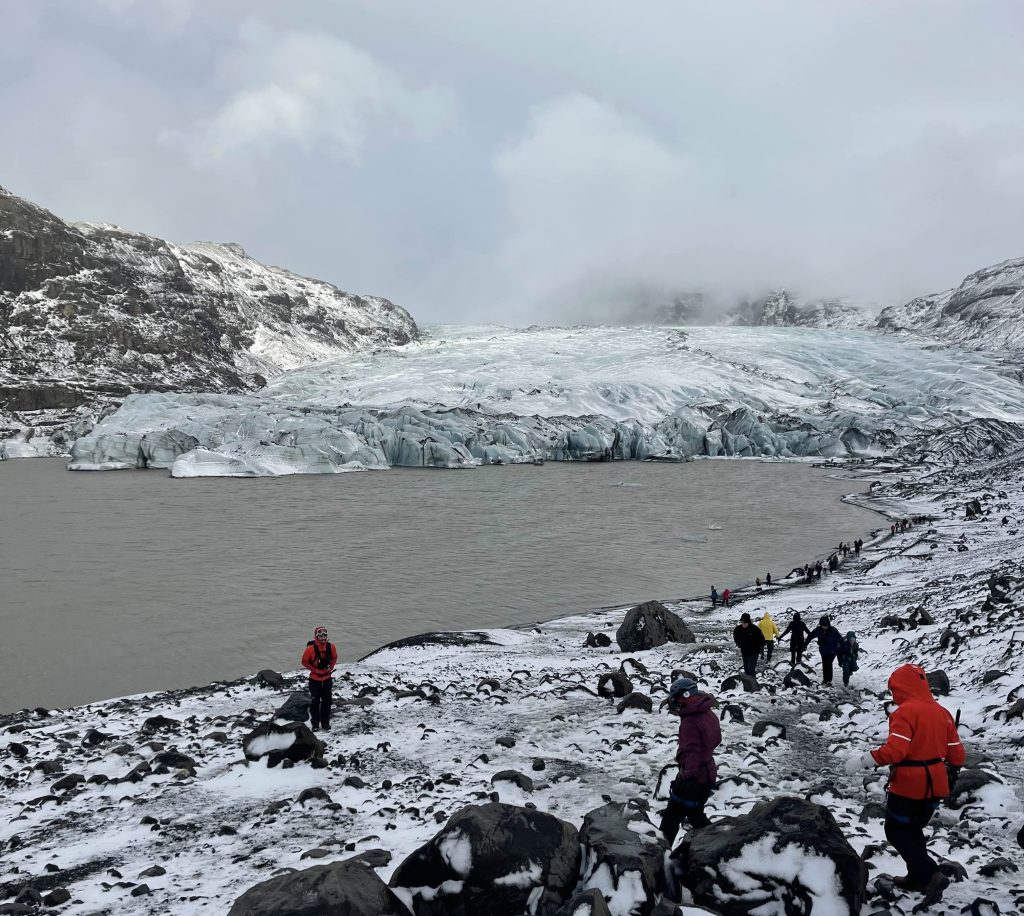
Today we made our way southeast across the island, stopping at the Skógafoss Waterfall, Skogar Museum, and Sólheimajökull Glacier along our trek. The terrain of the southern region of Iceland drastically varies in comparison to where we have been so far, but the sites still retain the same silencing allure. At every location we have been, there have been an endless supply of incredible views, natural beauty, and tourists.
As a foreign group ourselves, we are taking part in the controversial act of tourism, and there is never a shortage of people and languages that surround us at each and every sight, hike, and even gas station. Tourism can largely aid a country’s economy–so much so that it is the main source of income for many countries, and they are therefore entirely reliant on the flood of visitors that arrive from all over the world daily. However, in a place like Iceland where conservation is of the highest priority and the list of threats to their geography and bio life are lengthy, tourism also poses a challenge. There is no guarantee that tourists will hold the same high standard of conservation let alone understand what that means in the context of Iceland and how they can aid in the efforts.
To conserve the natural beauty is to allow it to act on its accord and not interfere with the processes that have taken place over the past millions of years. This proves to be challenging with tourists spilling into these sites to explore and take photos (that will ultimately never compare with seeing them in person). Despite this, there are choices that Iceland makes in an effort to reduce the exploitation of their environment and practice sustainable tourism. Such choices include having well marked paths, restricting certain areas from human traffic, including signage about taking out what trash is brought in, working to reduce soil erosion by thoughtfully building paths, and providing education information about the area. Hopefully with the continuation and improvement of these practices, the wonderful sites we’ve seen will be long preserved into the future.
 Swanson School of Engineering