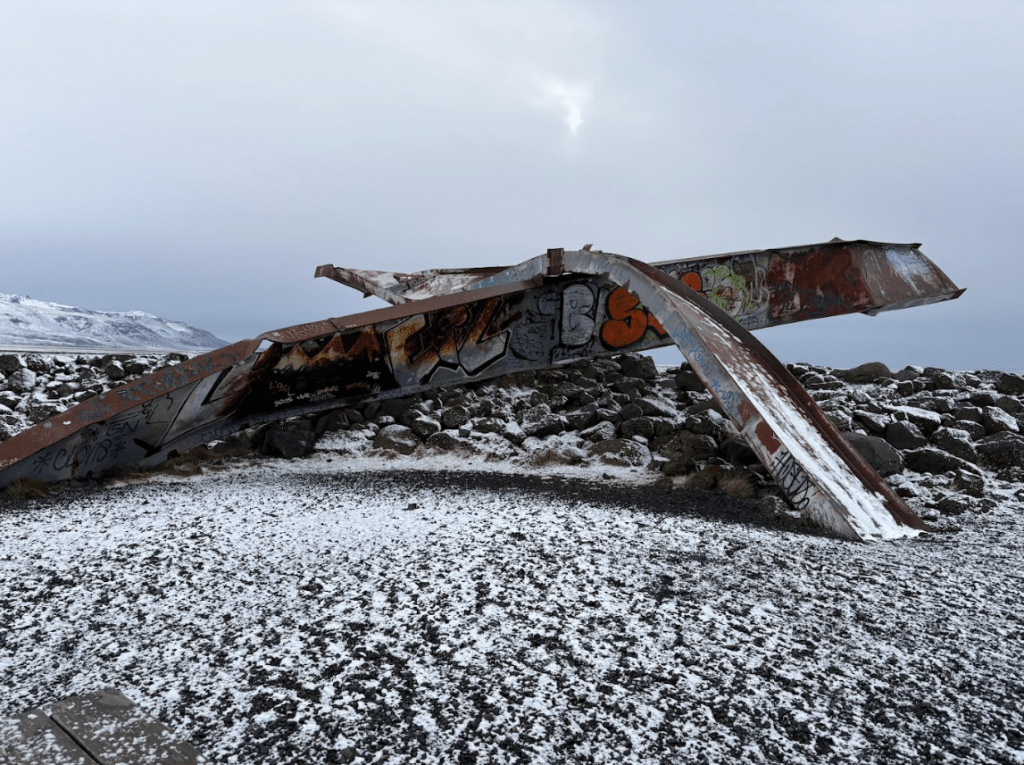
The Southern region of Iceland has faced a few different engineering challenges over the years with its extreme geological circumstances. One example of the damage done was a site we got to visit today: the Skeidara bridge. In 1996, the volcano named Vatnajokull erupted and caused a glacier to melt. That glacier caused extreme flooding and large shards of ice to crash into the bridge, which took the bridge down. To ensure this kind of disaster doesn’t happen again, the engineers made a few design choices.
For one, all the bridges in the area are a little taller than ordinary bridges since the engineers anticipated flooding. When the bridge was built, it was built to withstand the average flood, and not the largest flood they had seen in 1954. They left some margin of error as a safety precaution, but clearly it wasn’t enough, seeing as the flood of ’96 was far greater than that of ’54. The flood of ’96 itself definitely surprised scientists by the speed of the flood: a flow rate of 20,000 m^3 was expected, and the flood came in at 2.5 times that speed! In addition to the height being accounted for in the bridges, the bridge to replace the Skeidara was built on a different river, and is slightly smaller. So essentially the engineers learned to physically build around the geographical challenges.
 Swanson School of Engineering