Following our morning-midday cooking class at Ola Kala, we crossed the Charles Bridge over the Vltava to Malá Strana, the Lesser Town. Atop the hill lay Pražský Hrad, or Prague castle, from which the ruling families of Bohemia oversaw the city. For over twelve centuries the castle has served as a prominent fixture in the footprint of Prague, and while its age and cultural importance was easy to understand, I was most surprised by the way that context has evolved over the ages through to the modern day.
Originally constructed in the early 10th century by Bořivoj of the Přemyslid dynasty, Pražský Hrad has seen numerous expansions and restyles over the ages. Today, the front of the castle wraps outward in dueling wings to a small courtyard. A wide metal gate stands guarded by two soldier in decorative regalia, facing outward to another wide plaza that continues to ascend the hill. These front-facing building were an addition by Empress Maria Theresa of the Habsburg dynasty, covering the moat and front gate original to the castle. The moat, filled not with water but starved bears, served as both protection and a threat to any who attempted to assail the outer walls.
Across the plaza stands a metal statue of Tomáš Masaryk, known to Czechs as the father of the Czechosolvakian nation state. Both a product of and contributor to the National Revival movement of the mid to late 19th century, Masaryk was responsible for the opening of Pražský Hrad to the general public. Wanting to make Czech history free and available to the Czech people, there is today no security checkpoints, allowing free access to much of the outside grounds, despite the President’s residence within the castle itself.
Through the left-side entrance and toward the inner-wall, a small cutout in the side gate reveals the foundations of the old church of St. Vitus established in 930. Continuing through the tunnel, the new cathedral looms into view and stands out among the rest of the castle grounds.
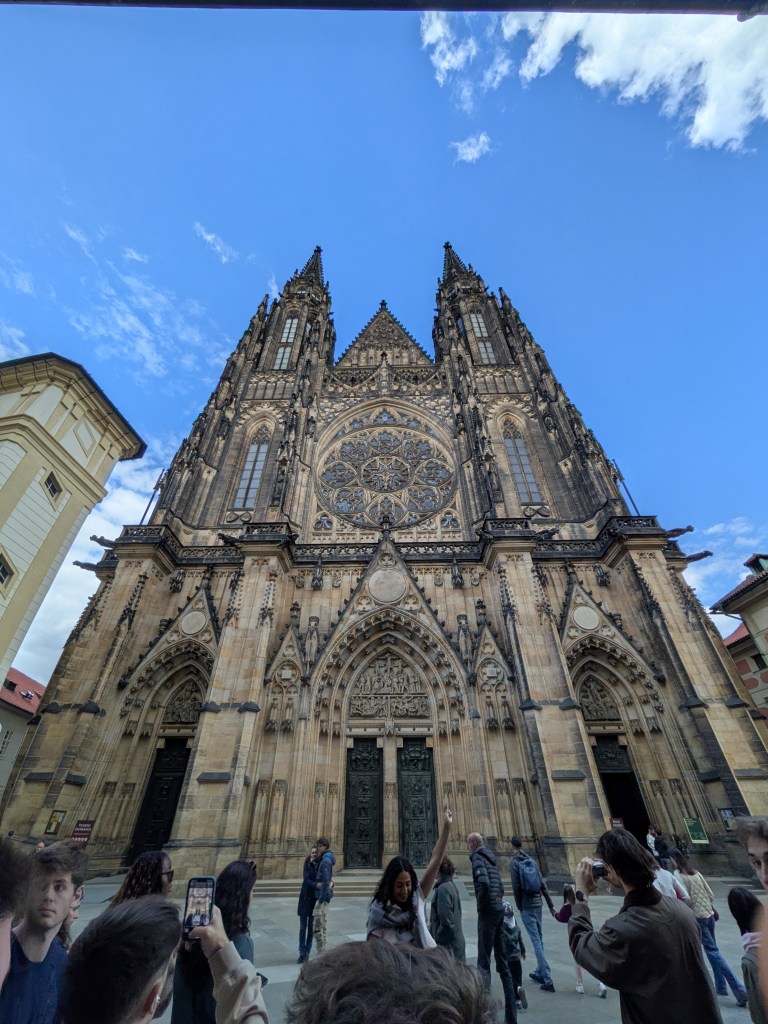
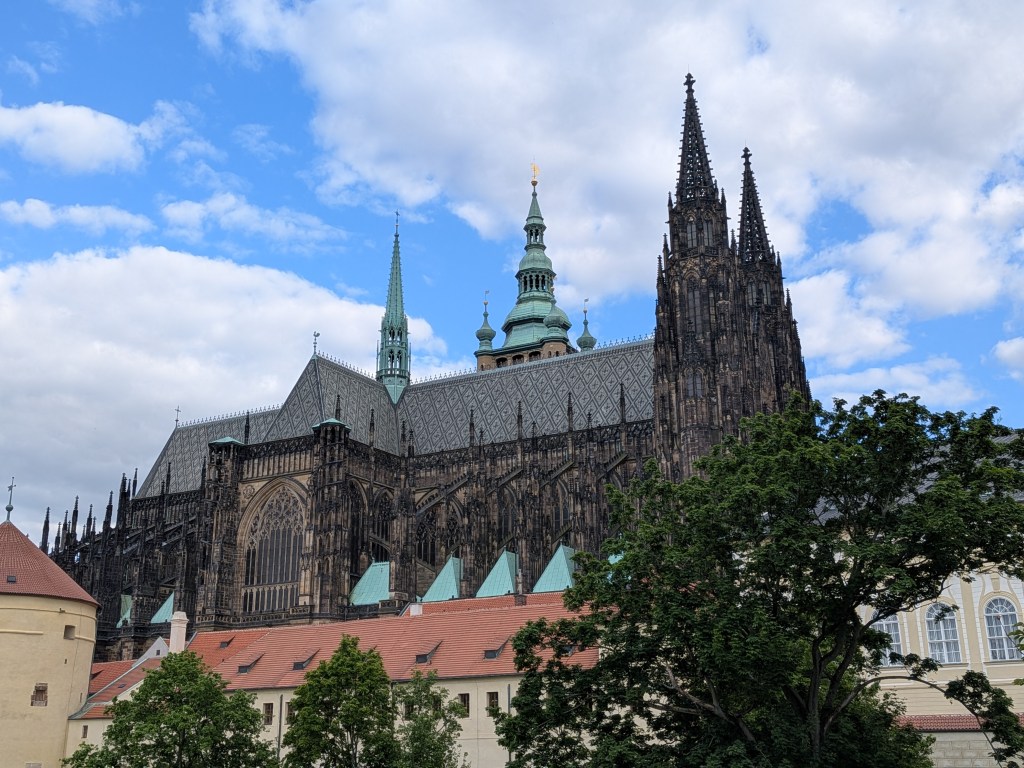
Visible from near any vantage point in Prague, the new St. Vitus cathedral astounded me the most. Its new construction began in 1344 under King Charles IV of Charles Bridge and Charles University fame, whose investments into the structure of Prague have endured centuries. While impressive in scale and intricate detail, the most peculiar fact of the construction was the date its construction finally completed… in 1929. For over 600 years and the course of four dynasties, into an independent and democratic Czechoslovakia, the cathedral sat under (at the very least partial) construction.
As we finished our round off the grounds toward the Golden Lane, we came across the latest addition to the castle grounds. Nestled behind the flying buttresses behind the cathedral and across the way from the imperial palace, a Starbucks now serves tourists among the centuries-old brickwork. While a little disappointing in comparison to the wealth of history in its immediate surrounds, the American chain is representative of Pražský Hrad’s constant and continued development to suit the needs of its modern uses. Since Masaryk’s opening of the castle to the public in the early 20th century, hundreds of thousands have flocked to the castle grounds to glean a stunning piece of the city’s history. In this, the castle has evolved beyond a historical or political entity, but into a piece of the public sector to be shared, appreciated, and pushed to develop as it has for centuries to suit the needs of its constituents.
 Swanson School of Engineering