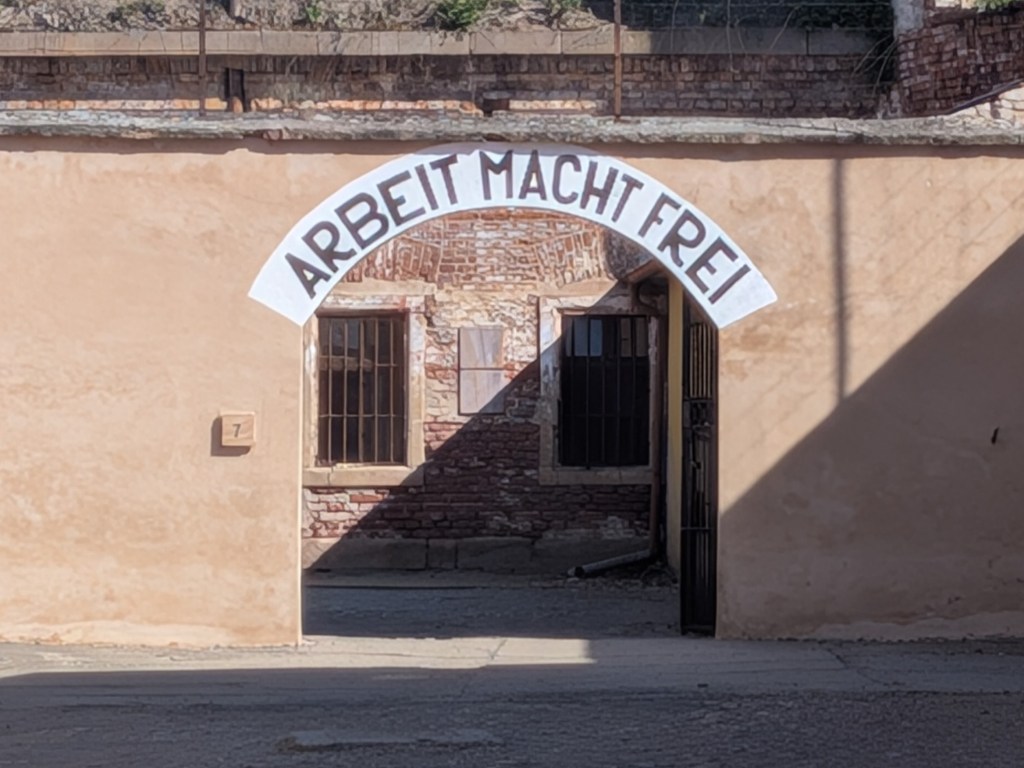
An hour north of Prague on the outskirts of the Sudetenland lies Terezín, an 18th century fortress named for Empress Maria Theresa who oversaw the original construction. By 1941 and under Nazi occupation, the fort and associated town served as the base for the construction of the Terezín concentration camp and ghetto. From 1941 to 1945, 150,000 people passed through the Terezín ghetto, many succumbing to exhaustion, malnutrition, and later rampant outbreaks of typhus and other diseases. Today, we visited what remains.
Originally constructed as a bulwark against Prussian aggression, the time Terezín spent as a fortress never saw battle. Instead, as the defenses remained operational, the town at the large fortress’ interior became a regional garrison, supplying and housing much of the army in the north of Bohemia. Not much of the construction was changed by the Nazi occupation, excepting signs and small interior renovations, leaving the bulk of the original site intact.
On our tour we passed through a series of short tunnels within the inner wall designed to mask troop movements during a siege defense. We crossed just 500 meters of 50 kilometers of tunnels networked throughout the fortress, winding our way from the holding cells to the shooting range and back courtyard. While the context of its mid-century use was heavy, I found myself fascinated by the complexity of Terezín as a fortress, and the thought that went into its original development. For such an interesting product of the late enlightenment period, I felt it a shame for an otherwise unique and independent history to be marred by a much darker one.
This is a trend, though, that I have seen in places all across the Czech Republic. Places aren’t built so much as they are rebuilt, again and again, generation after generation. Thinking back to the cathedral of St. Vitus and even the hotel we have been staying in, you can literally feel the old rooftops slope underfoot. Especially in the heart of the city, so many aspects have been quite apparently reforged and refined into their modern state, and that sentiment of continuous history paints every every building or site we have come to visit. In Terezín it was no different, with the efforts of the old empire pushed aside for the new, at the terribly unfortunate expense of those deemed outsiders.
The history of Terezín is different from the likes of Auschwitz or Dachau or Bergen Belsen; it was a transitional camp, were Jews and other persecuted peoples would be held before their shipment to one of the work or extermination camps listed above. This very nature allowed the Nazis to display Terezín to foreign agents, such as those of the Red Cross, to deflect any rumors of the genocide underway in the rest of the country and its occupied territories. The ghetto was renovated with parks and other amenities, and the small fortress was provided with new facilities never once touched by its prisoners to keep up the facade.
Though billed as such to the international community, those interned at Terezín were never free, nor would many of them be, as those unfit for work or considered witnesses after the visit from the Red Cross were deported to Auschwitz for extermination. Even after the liberation of the Czech Republic in early May of 1945, those at Terezín were forced to stay through mid-August as the entire area was under quarantine for Typhus. Of the 150,000 who passed through Terezín, only some 17,000 survived. Many of those in Terezín, though, were also culturally Czech, and as has been transparent in the rest of our visit have had knack for rebuilding and repurposing what little is available. What the Czechs have rebuilt on Terezín grounds today not only stand as a warning to the threats of right wing populism, but as a monument to the enormous efforts and emotional endurance of their people.
 Swanson School of Engineering