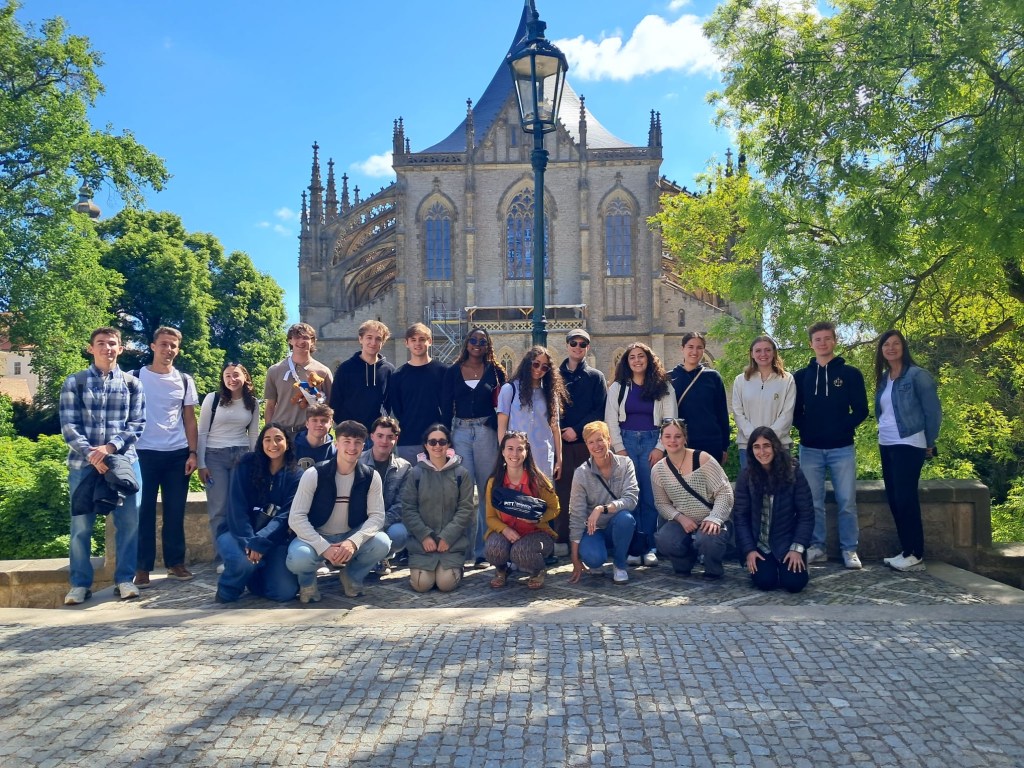
Today, we visited Kutná Hora and the Sedlec Ossuary. Our first stop was the Ossuary, also known as the Church of Bones. In 1278, the abbot of the church was sent to Jerusalem by the King of Bohemia. He brought back a jar of holy soil from Golgotha, and many people began to wish to be buried in the cemetery there. Eventually, a church was built with an ossuary—a storage room for human bones—in the basement. There were so many bones that the church hired a woodcarver named František Rint to artistically display the bones inside the church. The remains of about 40,000 people are housed in the basement. It was eerie but interesting to see how Rint chose to arrange them.
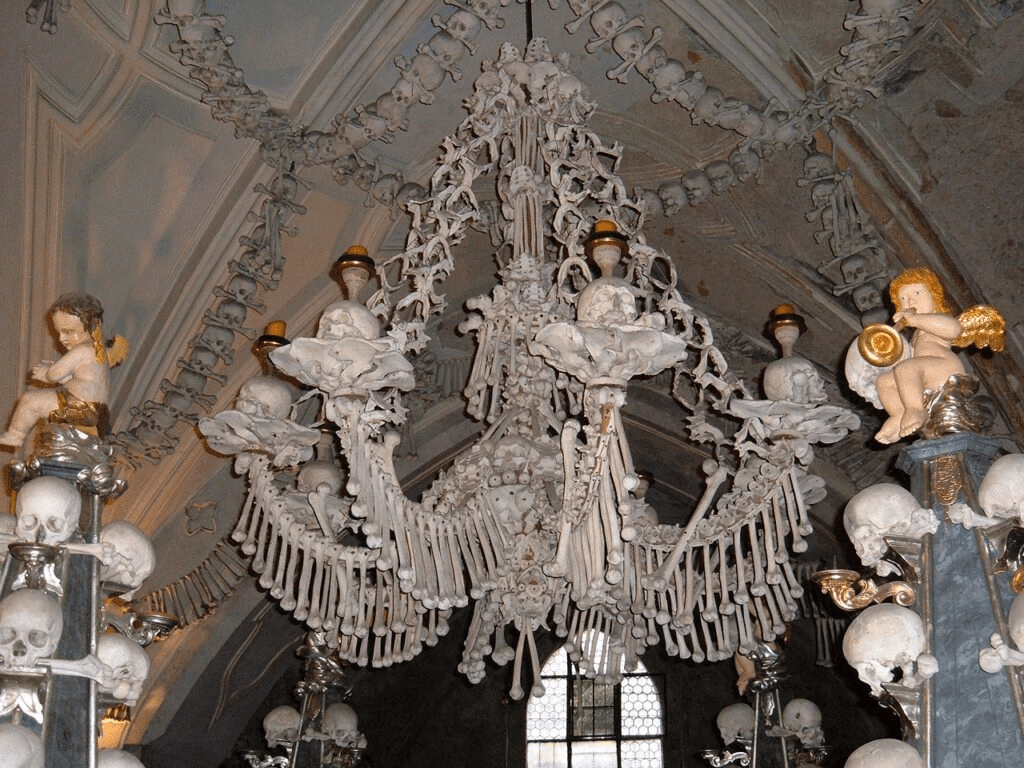
Photo Credit: https://sedlecossuary.com/
The name Kutná Hora comes from a story about a monk who discovered silver and marked the spot by placing his hat there. In Czech, kutná means “hat” and hora means “mountain.” We stopped at St. Barbara’s Cathedral, where we saw impressive architecture and learned about the renovations that took place over the centuries. Inside, you can see how the ribbing on the ceiling changes in design depending on the century during which the cathedral was being constructed. It was interesting to learn that the iconic tent-like roof was once replaced, but later reconstructed in its original tented style.
The cathedral’s architecture emphasizes tall walls and long windows. The shape of the windows was designed to let light stream in a way that symbolizes the presence of God. The ribbed ceilings help shift the weight of the roof onto the pillars at the edges of the room. Outside, flying buttresses form a lace-like structure that supports the building while adding to its beauty. A fun fact: St. Barbara is the patron saint of miners, and they traditionally pray to her for protection.

At the end of the day, we toured a silver mine. Miners often learned their trade through tragic trial and error. They drank water that ran into the mine, only to later discover it was poisoned with arsenic and other metals. Sometimes they accidentally tapped into flooded mines, which was often fatal. Many also suffocated, as they didn’t yet understand that rotting wood released carbon dioxide, creating lethal concentrations on the lower levels of the mine. Mining was an incredibly difficult and dangerous life—most miners didn’t live past 40 years old.
We were able to go into the mine ourselves, and it was cool to see the calcium deposits left on the walls from hard water trickling through the cave. I walked through very tight tunnels, and it was hard to imagine people spending their entire workday down there. At the end of the tour, we learned about their minting process. The Czechs discovered that lead and silver could be combined to create an alloy.
Overall, today was probably one of my favorites. I also really enjoyed the bus ride to the town, and getting to see the surrounding fields and villages along the way.
 Swanson School of Engineering