Located about an hour East of Prague, Kutná Hora is a town known for St. Barbara’s Church and Sedlec Ossuary, both of which we visited!
Sedlec Ossuary, also known as the “bone church” was our first stop. This is a Catholic Church known for its decorative use of skeletons. It is said that the church has the bones of roughly 40,000-70,000 people, many of whom died from either the plague or the Hussite Wars in the 1400s. These pieces are arranged in various patterns, with the skull be using prominently; however, they weren’t actually made into these decorations until the 1800’s. The eerie artistry provides insight into the Czech “approach” to death. In the Sedlec Ossuary, death was portrayed in a celebratory manner rather than a fearful or far-removed one. After getting over the initial shock of seeing so many human bones, the space felt oddly peaceful. This experience reminded me of all of the Czech history that we have learned thus far, and all of the stories of each individual whose remains were carefully crafted to make a unique space.
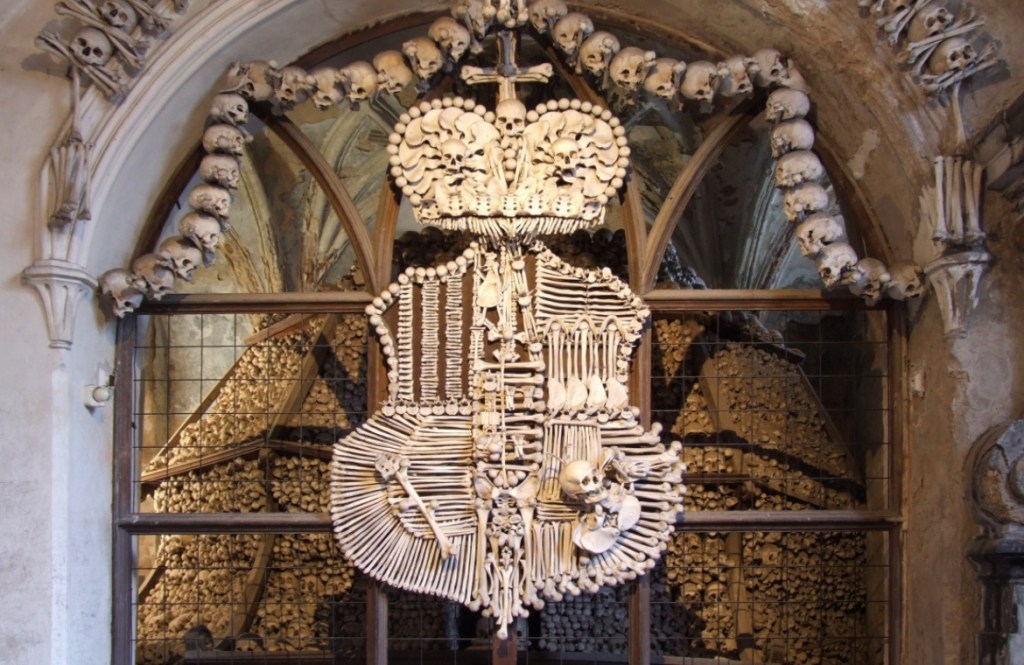
(Image taken from sedlecossuary.com)
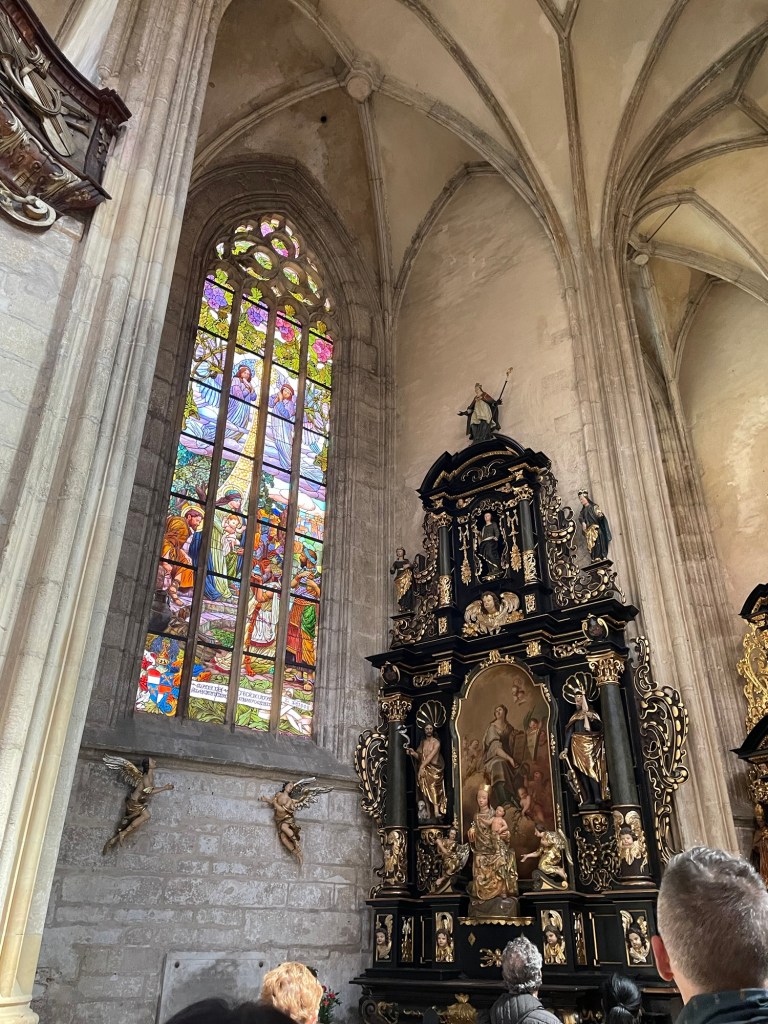
Our next stop of the day was St. Barbara’s Church. Looking at it from outside, I noticed the unique supporting arches on either side of the building. Our guide Jana explained to us that as repairs and upgrades were being made, the structure needed more support, hence these members. As a civil engineering student, I found this quite interesting. When we went inside the church, I was in awe with its beauty. The stained glass art was mesmerizing, as well as the ceiling. All of the light that could be let into the church was said to be God entering the space. This was easily one of the most remarkable churches I’ve ever visited, and an incredible space to exist in. The intersection of art and engineering here was super interesting, and I plan to do some more research on the matter!
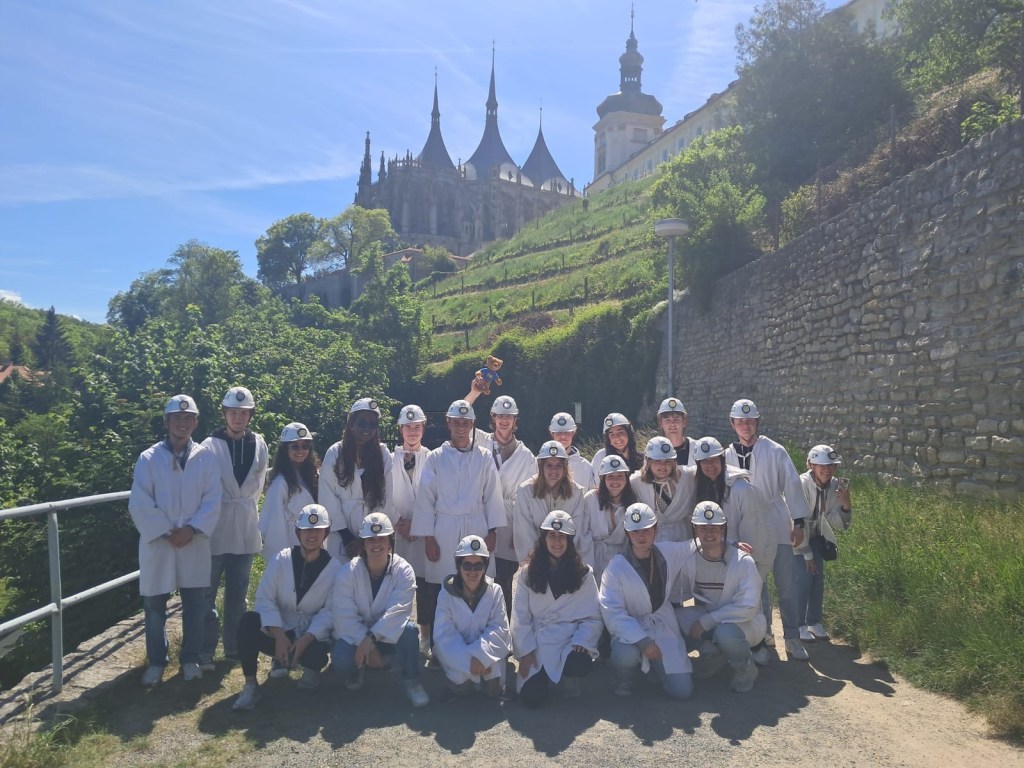
Finally, our last major stop of the day was a tour of a silver mine. Mining plays a significant role in Kutná Hora’s history, helping it to grow socially and economically. However, as we learned through the tour, this job was incredibly dangerous and grueling. Miners would spend an hour or two just to get down and up. They were working in humid, dark conditions with scare ventilation. Many died on the job. Our tour was very much safe and controlled, however. While there was no more remaining silver, we walked (and crouched) our way through the space. The walls were covered with hardened calcium and limestone, which has accumulated overtime. This experience provided insight into the engineering-like operations of the mine, from mining the silver to getting it up and out of the caves. It also left me with a profound appreciation for the Czech people and their resilience in far-from-ideal situations. I’ve felt this sense of awe and gratitude throughout the trip, so my experiences today were very reaffirming of that.
From all three experiences combined, I feel as though I learned about this town from economic, social, and spiritual perspectives. Getting a well-rounded taste of Kutná Hora was awesome, diving into history with some engineering flair. Further, we experienced a duality of spaces, some tall and magnificent and others crammed and dark.
What a successful day!
 Swanson School of Engineering