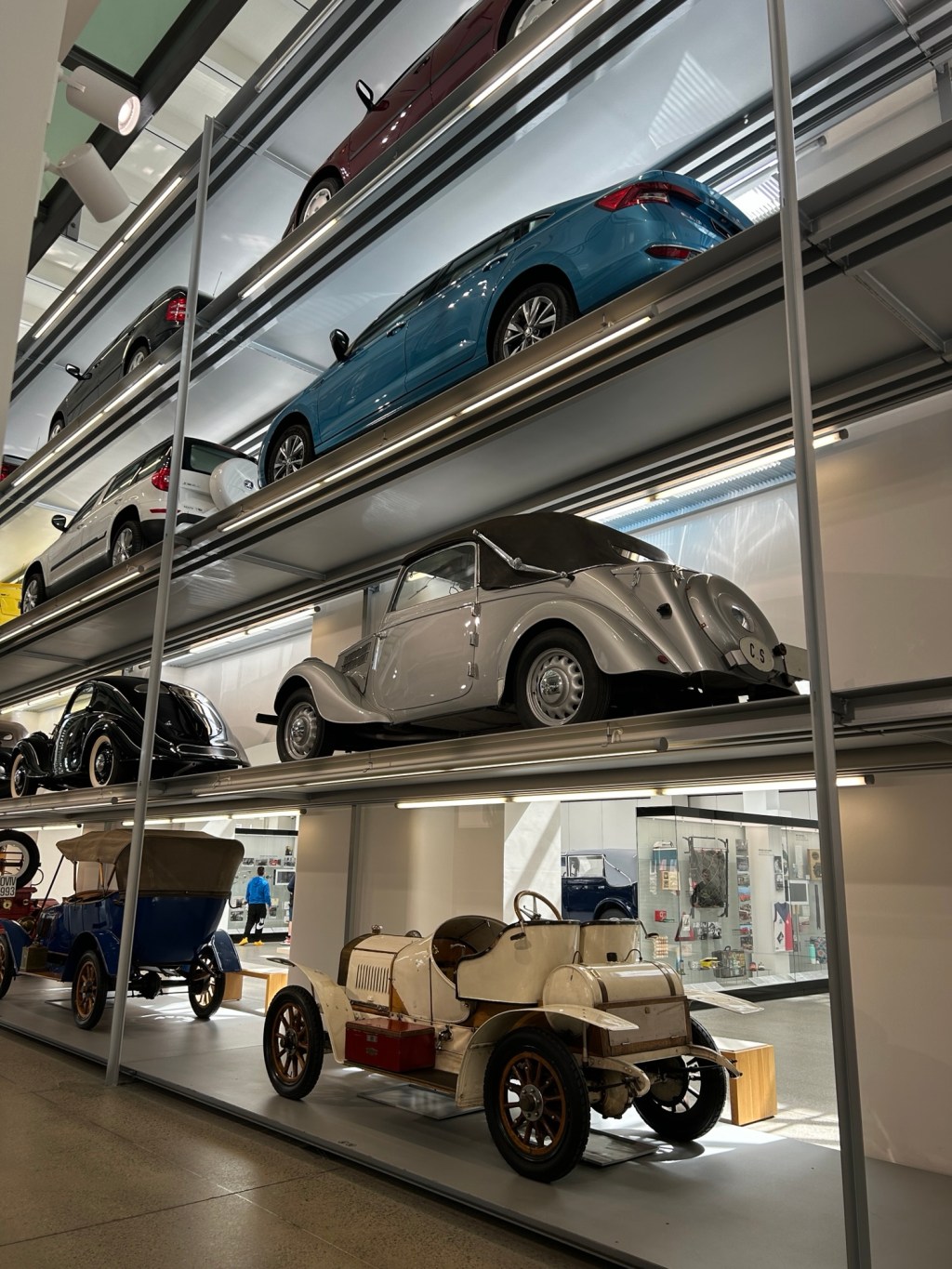
Today we took a trip about an hour and a half outside of Prague to visit Škoda, one of the oldest and most iconic car manufacturers in Central Europe. It was fascinating to learn that Škoda didn’t actually begin with cars—they started with bicycles, slowly evolving into motorcycles and eventually into the well-known automobiles we see today. Our first stop was the Škoda Museum, where we got a walk-through of the company’s rich history, starting from their very first hand-crafted bicycle to their latest car models. Seeing how much the brand has grown over time really helped me appreciate the engineering milestones behind every phase of their development.
But the highlight of the day was without a doubt the manufacturing plant. Watching the production line in action felt like stepping into a well-choreographed performance. Each employee was focused on a specific part assembling doors, fitting dashboards, tightening bolts, and together, their work moved in such a rhythm that it was both efficient and impressive to witness. What stood out to me was that unlike many other modern car manufacturers that rely heavily on robotics, Škoda still has around 2,000 human employees working the line. I found that really meaningful it’s not just about automation here, but also about sustaining local jobs and communities.
We wrapped up the visit at Škoda Motorsport, which was such a cool experience. Škoda plays a major role in the world of rally racing and is actually a World Rally Champion. Seeing their race cars up close, along with the special modifications that go into designing high-performance vehicles for such demanding conditions, gave me a new appreciation for motorsport engineering. Although this was a part of engineering that I previously had very little to no knowledge on, I was very intrigued by the manufacturing attention to detail that Skoda puts into satisfying its clients.
 Swanson School of Engineering