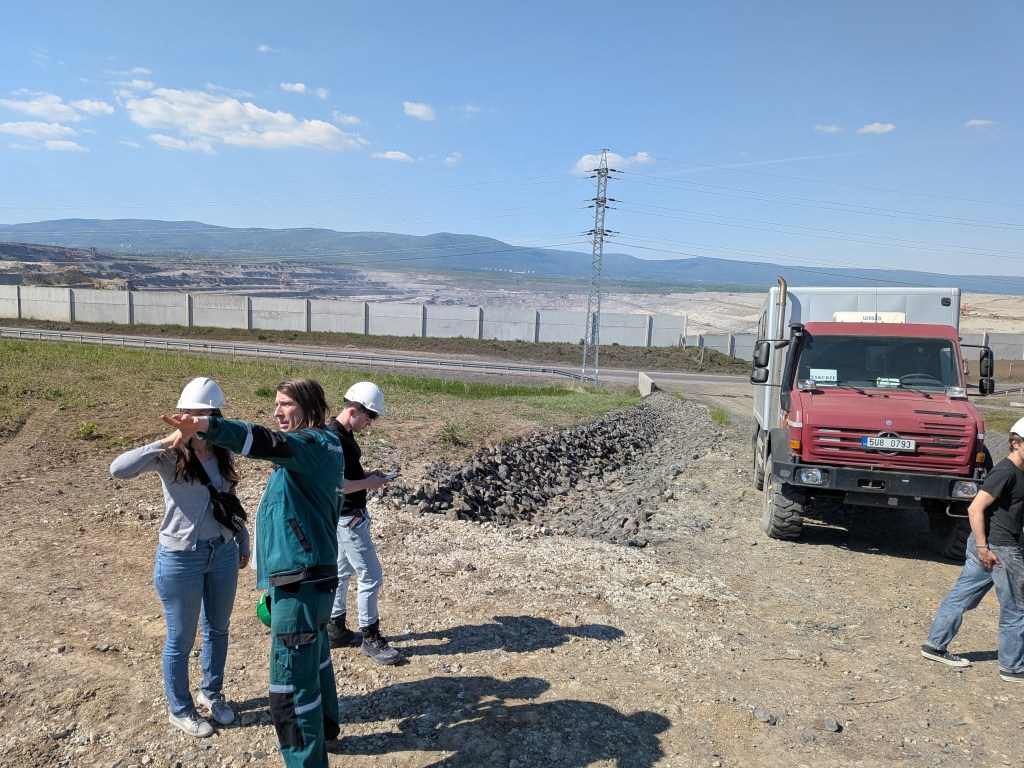
Our day at ČEZ saw us visit their coal-fired powerplant on Ledvice and the neighboring Bílina strip mine that feeds it. Through a guided tour we ascended the coal-fired boiler to an observation deck above the plant. Along the northwestern horizon the Elbe Sandstone Mountains that form the border with Germany. To the west, the mass face of the open Bílina mine sprawled some 44 square kilometers between a spattering of rural towns and villages.
The interior of the boiler room was daunting, with what looked to be hundreds of kilometers of pipes and other equipment. One of the guides had a tablet with a 3d model of the space, and the twenty seven floors above us were a rat’s nest of utilities. While I originally understood the necessity for work across disciplines, our trip to ČEZ really cemented that sentiment. From the steam pipes to coal-feeders to fuel washing to utility connections and more, every discipline of engineering was represented. On a project as large and complex as the boiler at ČEZ, every skill set is needed to achieve even its base function.
After our tour of the plant we descended into the Bílina strip mine where surface deposits of lignite, or brown coal, are harvested to feed the plant. The philosophy present at the core of the plant was too reflected in the mine, where massive pieces of machinery needed to be maintained and organized to optimize output. We stopped at multiple locations within, including the deepest part.of the mine, which maintained the lowest open-air surface in the Czech Republic.
In the roughshod piles by the carved-out walls of the strip mine we foraged for pyrite, also known as fool’s gold, that lies useless (in terms of energy production) and dispersed all throughout the gravel. Mostly dust, the ground was unfathomably soft and demonstrates the exact scale of extraction at the site. Beyond the equipment and engineering behind the mining methods, there would also be much work to do with reciprocating and restoring the habitat of the surrounds.
Our final stop was at the top near the lip of the mine where re cultivating processes were already taking place. New drainage systems were installed and trees were planted, but most interesting was a small shack on the hill used to measure the ground stability. Using a mechanism of lasers and mirrors, the crew could monitor in real time changes in the leveling and topsoil, which could sound the alarm for erosion and other shifts in the sediment.
It was really cool to see how the power plant implemented so many systems outside of power transmission, with which I am more acquainted, but the extent of civil,.mechanical, environmental, and industrial technologies behind the whole of the operation. If anything it assures me that my choice of major won’t necessarily limit me to a particular field or technology. Instead, it is the space between disciplines that fosters the most innovation and is most reflective of real world applications.
 Swanson School of Engineering