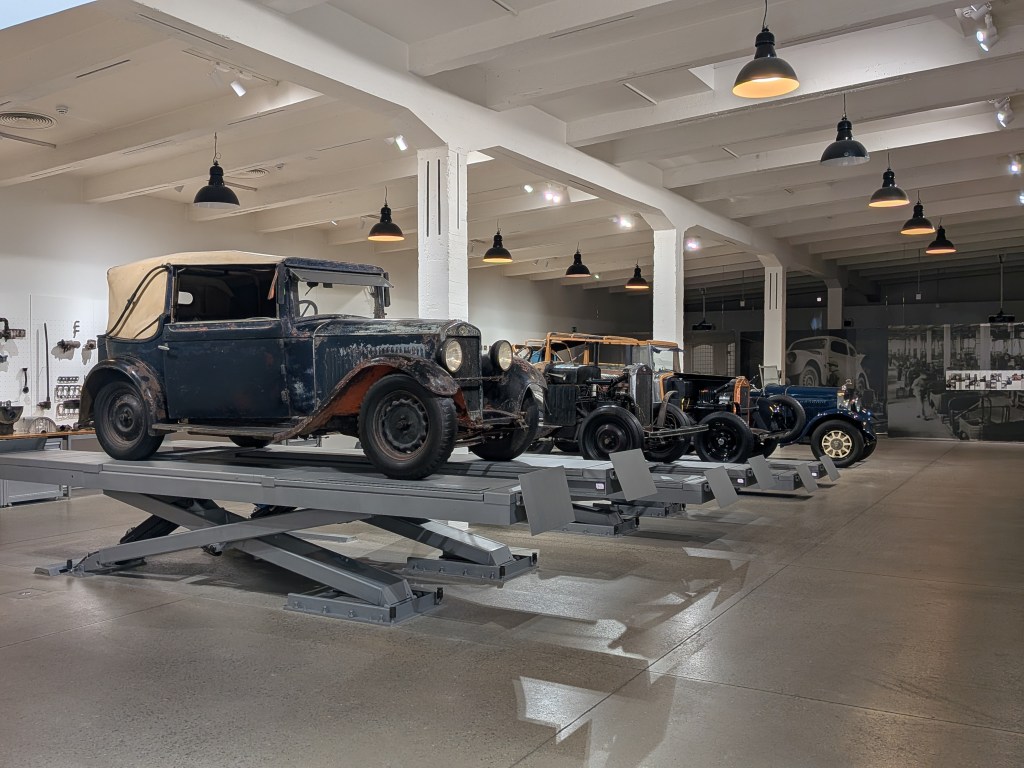
Last week during our history of engineering lecture it was mentioned that the automotive industry was historically and remains crucial to the economy of the Czech Republic. Representing around 5% of the country’s GDP, Škoda Auto both demonstrates that capacity and reliance. In a rare, behind-the-scenes opportunity, we were given the chance to tour not only their museum, but also their mainline assembly plant and motorsport development team in Mladá Boleslav.
Our guide through the museum was brief but comprehensive. Škoda was celebrating their 130th anniversary since the founding of Laurin & Klement (later to become Škoda) which started in the industry by manufacturing motor-powered bicycles. In the modern day, Škoda is a part of the Volkswagen group, acquired so after the Velvet Revolution of 1989 and the dissolution of state-ownership structures. During the period from 1948 to 1989, Škoda was mostly restricted to the other Eastern Bloc countries in terms of sales, and since Volkswagen’s acquisition have been primarily sold in the German and broader European markets, making them an exceptionally rare find in the U.S.
The technical highlight of our visit was our tour of the assembly plant and body-press factories, where we saw teams of laborers and robots working together to produce the Škoda bodies so prevalent across the country. Photography was restricted inside to prevent corporate espionage, so hopefully my words can better illuminate the experience.
The main assembly line was comprised of a series of loops on which large platforms housing the auto bodies rested. The loops were automated and slowly moved across the factory floor; teams of workers walked these moving platforms while installing various components into the painted bodies, mostly dashboards in the sections we walked through. Both workers on motorized carts and autonomous robots ported materials down the center lanes, keeping the assembly line workers stocked up and with enough material to hit quota on schedule. The press shop was also fascinating. As opposed to the assembly line, the press shop was a majority automated operation, with hundreds of articulated arm robots manipulating mainline both assembled components (doors, fenders, etc.) and smaller pieces from a massive mechanical press with hundreds of custom tools for other press-shapes in storage. Most of the staff there were technicians responsible for maintaining and overseeing the automated production as opposed to the largely manually staffed assembly line.
The scale of the operation was astounding. The plant is so large that is consumes most of Mladá Boleslav and required our bus to take us from building-to-building on the campus. While I understood Škoda was an essential part of Czech industrial output, it wasn’t until our tour through the actual factory grounds that I understood the scope and implications of the dedication to the industry.
We finished the day off at Škoda Motorsport, which today supplies teams across the globe in Rally 2 events. After a presentation from their staff, we were walked through the design process for their Fabia rally cars and got a small look at the workshop where they are made-to-order. Before Škoda designed cars for sale in the global rally market, they ran their own branded rally team. While the project was closed for financial reasons, you could tell from quite a few of the professionals we talked to that they missed that era of the company. The sentiment is reflective of the wide scale where Škoda is an element of national pride. As one of the few surviving Czech brands after the 1989 divestment, Škoda continues to represent Czech engineering on an international scale, and the technology and infrastructure behind that development is truly impressive.
 Swanson School of Engineering