As learned last week during our visit with the Bohemian Innovation Center, funding guidelines and political red tape restrict the development of research and development centers in Prague proper. As a consequence, most of such facilities are constructed in the outlying suburbs of the city like Eaton’s European Innovation Center. With close ties to the University of Pittsburgh, Eaton is a global company specializing in power distribution systems and networks. In a guided tour of the EEIC, we were given an opportunity to investigate their facilities and the surprising diversity of their portfolio.
Originally in the automotive business, Eaton eventually translated their expertise into power delivery systems. Now, their work stems everywhere from full grid implementation, to onboard electronics and other components for aerospace, and local power delivery systems for electric vehicles. While I knew them for their grid and arc modeling lab back in Benedum, it was really cool to see the various fields in which their expertise was applied.
The highlight of the visit in my eye was when we got to talk to the researchers at their microgrid lab. Opposed to the mainline grid, a microgrid essentially encompasses one building and can harvest additional energy from solar or other sources to either store or sell back to the main grid. The researchers there had their system hooked up to the whole of the EEIC, including a DC/DC supercharger in the garage for company EVs. We had a really interesting chat about methods of EV charging from low to high power charging, certain drawbacks for each, and also battery-swap recharging methods. Out of all the technologies showcased, I believe the microgrid applications will be the most impactful; with the price of photovoltaic cells dropping and EVs becoming more prevalent, establishing a microgrid at home will not only allow for greater energy independence, but could also open up opportunities for development in remote areas where access to a larger municipal grid is challenging.
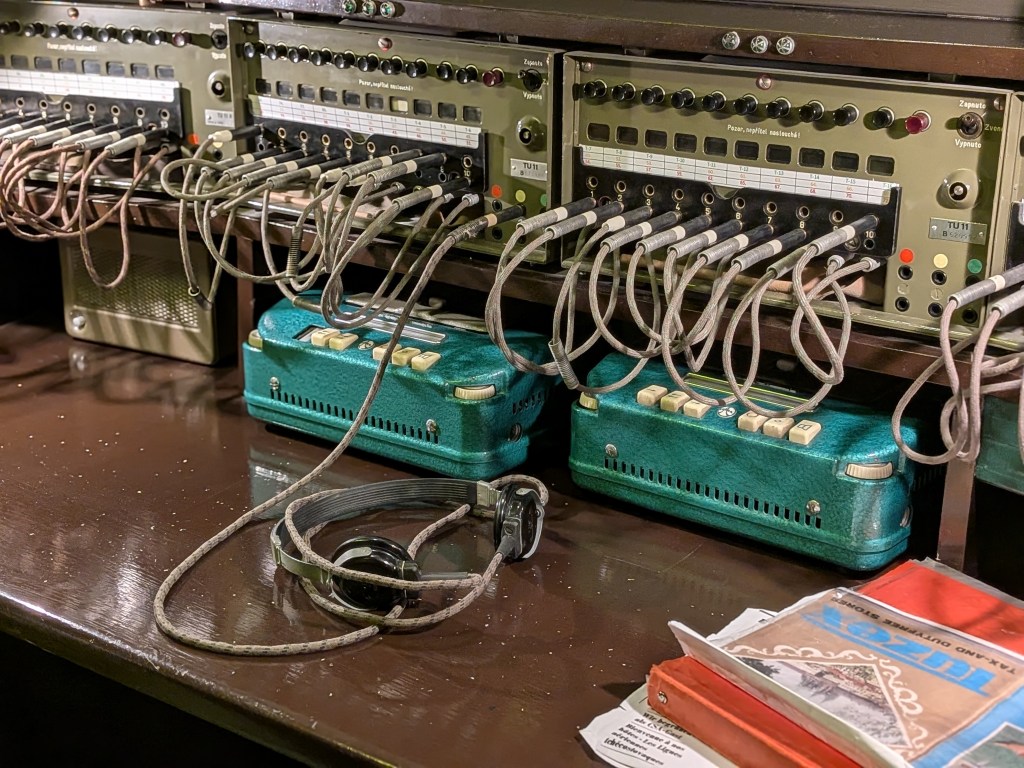
We ended the afternoon at the Cold War bunker museum at Hotel Jalta, just off Wenceslas square. Constructed in the mid-to-late 1950s, the bunker was established in two halves: one for the important hotel guests, and a secret portion for the secret police, and later, military personnel. From the secret bunker a mass wiretapping relay was established to spy on certain rooms in the hotel, those used by foreign diplomats and politicians visiting from the West. In the switchboard room there was a color-coded map of the different rooms in the hotel marked for wiretapping. Green rooms were never listened to and reserved for ranking Soviet members to maintain internal security. Yellow was sometimes listened to and reserved for Czechoslovak nationals and other members from the Eastern Bloc. Red was always under surveillance exclusively hosting important figures from the West. Beyond the history aspect, it was really cool to see all of the networked equipment that went into establishing the surveillance operation in the hotel. Other rooms in the bunker included an air defense map, small armory, medical unit, and air filtration pump. Just like the microgrids, everything was built to operate independently from the wider city services in the event of a nuclear scenario. Preserving the space not only serves as a memory of the events of the time, but can also serve as template to reuse in modern day contexts.
 Swanson School of Engineering