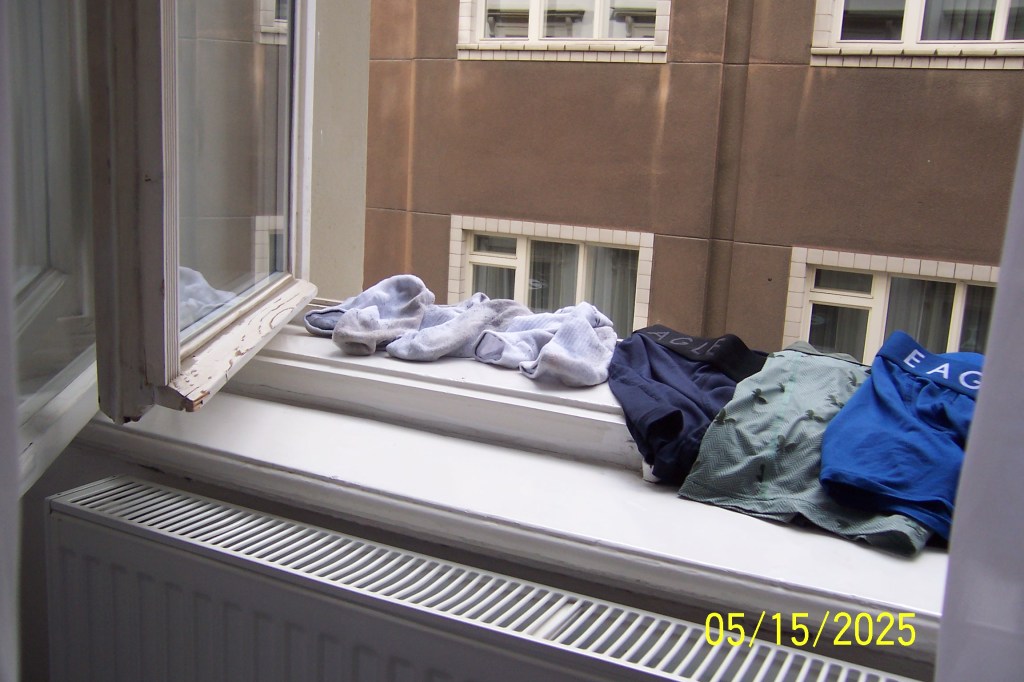

This post may or may not be appropriate, but it is accurate and represents events that actually occurred today, so I feel inclined to include them. Let me just cut to the chase. Yesterday (today being Thursday, May 15th), I officially ran out of underwear and socks to wear, so I had to wash them (but with what time??). Considering that our days are so packed, I and, believe it or not, many others decided to wash our clothes in our sinks using dissolvable detergent pods. This engineering-level idea originated from the one and only Alex (mechanical engineering student) on the trip, so thank you Alex! The problem is that, after washing the underwear, there is no way to dry the garments quickly due to the lack of…well…a dryer. For this reason, I laid my garments out on my window sill with the windows open. Hopefully, after this post is all said and done, the other individuals that did the same washing method follow suite.
With regard to actual engineering topics, the Cold War Museum seemed to incorporate a number of innovative techniques for dealing with a nuclear blast. This museum was essentially a bunker underneath a hotel, and it was preserved immaculately. They claimed that a lot of the equipment and uniforms were original, and nothing seemed to be too damaged beyond recognition. This gave us, as visitors, to take a glimpse into the past as well as a perspective of modern engineering at that time.
One thing that was particularly fascinating was the air filtering machine. Since the bunker was designed to withstand a nuclear fallout, the bunker had an air intake for oxygen, but the inhabitants knew that they could not simply break in the air from the outside during a nuclear fallout. As a result, the air intake system had in series an entire barrel of a certain type of coal. The purpose of this was to absorb radioactive particles before they could reach the inhabitants lungs.
This reminds me of nuclear reactors. Nuclear reactors often use control rods to slow down or speed up the reaction that generates energy. As control rods are inserted into a nuclear reactors, the reaction slows down because the rods are made of carbon, which effectively absorbs radioactive particles. This is the same reason coal was used on the air intake system, for coal is made from carbon.
Ultimately, we also spent some time during the evening on a ghost tour of Old Town Prague. this experience was fun because of the history told on the tour as well as the good laughs shared with friends (see the captured image of the ghost [Becca] below).


 Swanson School of Engineering