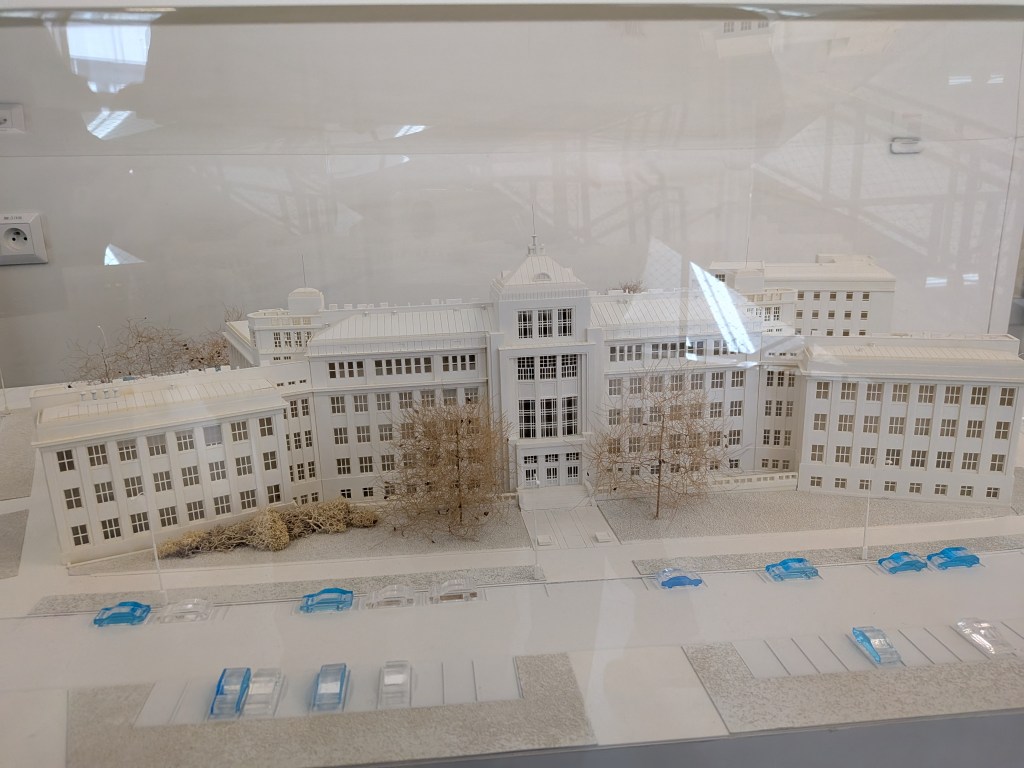
Yesterday we visited the IOCHB, or the Institute of Organic Chemistry and Biochemistry here in Prague. The last official visit on our list, we were given the opportunity to speak with members of the institute from various projects including the development of new molecular structures and cancer resistance research.
Classically averse to most topics within the sphere of chemistry, I was quite surprised with what the IOCHB elected to show us. The piece of research I found most interesting was the concept of photo motors, or molecular structures that can change their orientation. When exposed to stimuli such as heat or light, these photo motors flip or ‘rotate’ the arrangement of their structure, resulting in a chemically similar compound represented in a different state. There are many types of discovered photo motors, each with different numbers of turned-states and half-lives; that is, the amount of time it takes to translate from one state to the next. The latter parameter can be influenced by the amount of energy added to the system through heat or light, making photo motors with half-lives thousands of years long still usable.
My interest cropped up where the technology began to intersect with my background of study, particularly with regard to computing and robotics. Since these molecular structures have definable states, if we can create a technology that can sense the individual states of multiple photo motors in a cluster, we would have a way of storing information similar to transistors but on a molecular level. In addition, since there exists photo motors with more than a binary set of states, we could design architectures in new number bases for a denser collection of data; of course, we would have to evaluate which type is more space efficient, but the idea still stands.
With regards to robotics, our presenter Jiří Kaleta demonstrates a theoretical concept using photo motors to mimic flagella. Similar to bacteria, their spinning motion could propel the rest of the structure, or attached structures, through a medium. Bacterias accomplish this through some base form of intelligence to navigate and collect necessary chemical compound, and at this point we have no way of adding such intelligence to simple molecular structures. If we were able to manufacture some basic processor using photo motor clusters, however, we may be able to attach more to act as flagellum to propel the entire structure to accomplish some.other task, giving us a new form of nanites.
It was really interesting to see a technology with direct applications in my field even though it’s current body of research came from another, and one I am not the greatest at nor fondest of. Within the contexts of chemical batteries and other technologies, the overlap makes sense, but it was fascinating to find a connection in such a niche category within both fields.
 Swanson School of Engineering