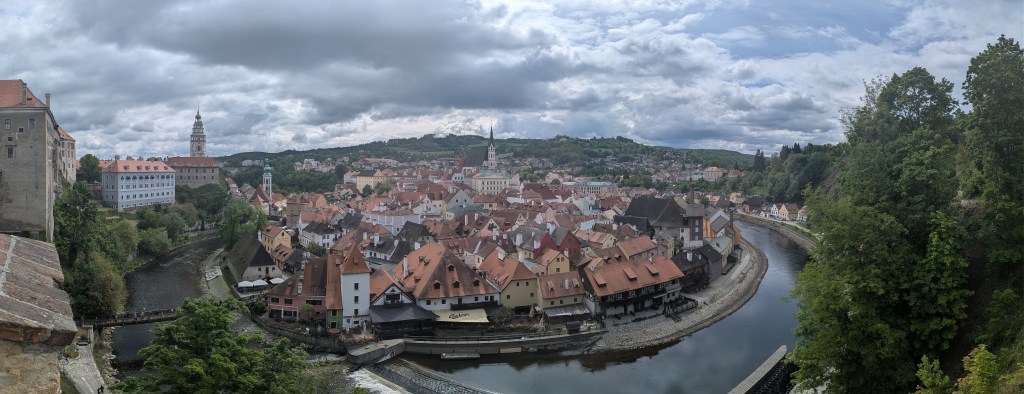
We spent our last full day in the Czech Republic with a visit to Český Krumlov, a historic town up the Vltava near the border with Austria. There, we visited the hilltop castle and toured its halls before spilling across the river and into the town proper. Nestled in a curl of the Vltava and striped up and down with cobblestone pathways, walking through Český Krumlov felt like being transported to the 18th century.
The castle complex at Český Krumlov maintains a history baked in uncertainty. It is unclear when exactly the castle was constructed, as records point to some manner of fortification on the hill dating back to the 11th century. It was only later into the 13th and 14th centuries did proper development occur, finally landing the property into the hands of the House of Rosenberg. One of the more politically significant families in Czech history, the Rosenbergs were heavily involved with both local and greater Bohemian rule with many members of the family holding positions in the royal court in Prague through the 17th century. The Rosenbergs instituted major renovations and extensions of the castle complex bringing it in line with the popular Renaissance style of the time.
The Rosenbergs died out in the 16th century, leading the Emperor Ferdinand II of the Holy Roman Empire to grant the castle grounds to the Eggenberg family. This did not last long, as the Eggenbergs themselves died out by the beginning of the 18th century, leaving the castle and surrounding lands to the House of Schwarzenberg who were responsible for the Baroque restyling of the complex, again bringing the grounds in line with the modern sensibilities. The Schwarzenbergs maintained control of the castle through the second world war whereafter the Eastern Bloc-aligned state of Czechoslovakia absorbed the property and others like it across the country. Today, the town stands as a UNESCO World Heritage site and the center is preserved in the antique styling of centuries’ past.
The interior was intricate and flush with feasting and reception rooms, ballrooms, dormitories, and an interior church. The guide provided a wealth of information from the use of each room to even the customs and traditions practiced. In one of the first audience chambers, there were a series of ornate cups that the visiting nobles would be made to drink from. It was seen as polite to drink (or at least attempt) the entire two and a half liters of spiced wine in a single gulp. Realistically, even if it were water you would die of water intoxication, but the practice was primarily used to get the guests drunk and honest, making later dealings easier. Many rooms were also adorned in great bearskin rugs from previous guardians of the castle. Just outside the main wall, and to this day, there is a moat with bears. A bear moat. With bears.
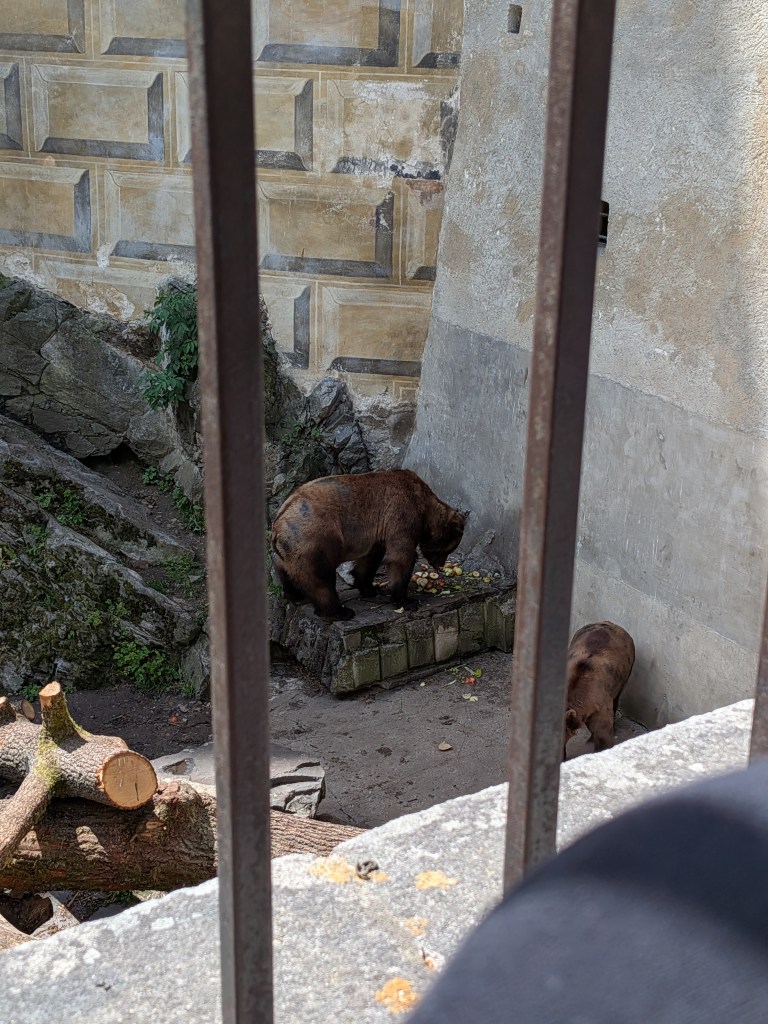
This was a rather common practice across Bohemia historically, though new laws have been put in place to phase-out the program and cease the replenishment of bears to the moats once they die of old age. These two bears are actually Russian, and were seized at Václav Havel airport en route to elsewhere in Europe likely for sale into a circus.
Of the different cultural visits and excursions we attended during our time in the Czech Republic, Český Krumlov was definitely a highlight. No other place we visited, not even Kutná Hora, reflected the same time-in-a-bottle sensation present in the town. The castle was breathtaking, both in its stature and the view it provided of the town center. It was unfortunate that we got so little time to explore, but it is somewhere I would love to return if I find myself back in the Czech Republic.
 Swanson School of Engineering