Gleðilegan þriðjudag! (Happy Tuesday)
Welcome back to our fourth day in Iceland, and one of my favorite days so far. This is gonna be a long one, so if you want a quick read, this is not that. I promise I will try to keep it funny throughout.
We started the day by making our way to the first waterfall of the day, Seljalandsfoss. Before we arrived, we stopped at the Lava Center for a quick break. There, Ólöf showed us a map of Iceland with all of the volcanic activity and recent earthquakes from the last 24 hours. Apparently, there was an earthquake near our hotel area, but either I was completely exhausted and sleeping like the dead, or it was very tiny.
I find it strange how Icelanders can point to a volcano, confidently say that it is overdue and could erupt any time between now and the next few months, and not panic at all. Especially when you learn that volcanoes under glaciers can create flood waves that are over 40 meters tall. The casual attitude toward natural disasters is wild.
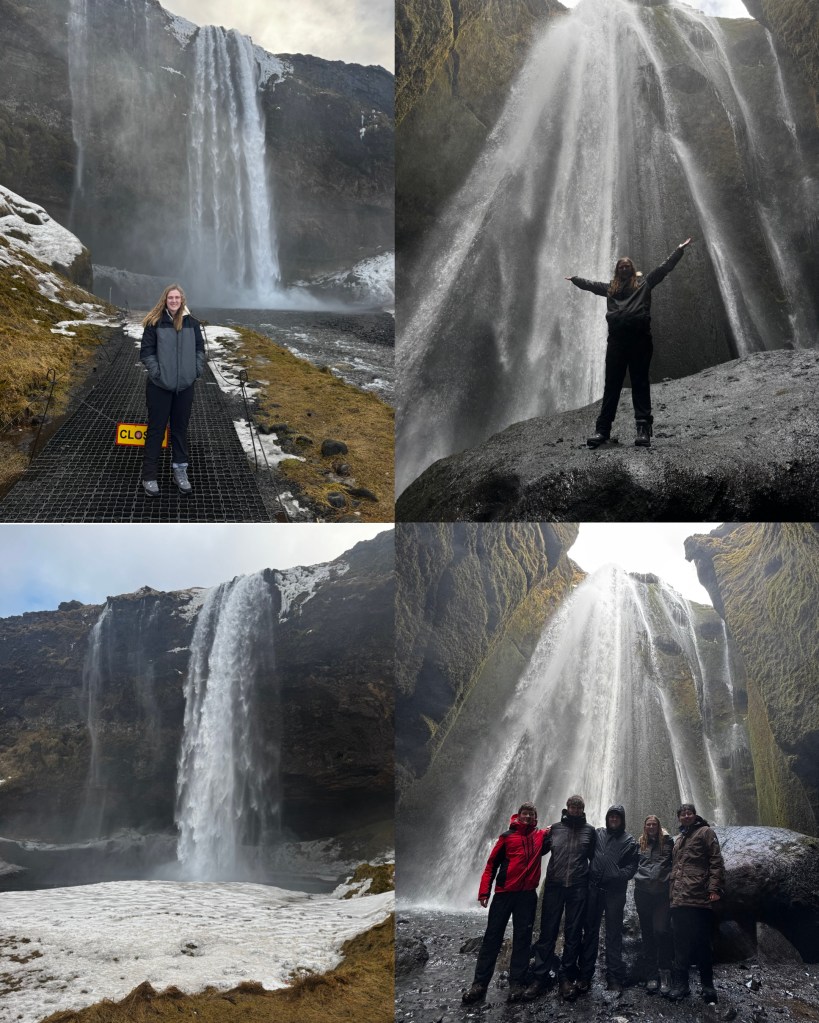
Once we got our dose of coffee and volcano information, we finally arrived at Seljalandsfoss. One thing you will learn here is that Icelandic names are very literal. It is basically like naming a cat “Cat.” This waterfall’s name is made up of Seljalands and foss. Seljalands refers to the farm, area, and river, while foss means waterfall. So this is literally the waterfall of Seljaland. If only America were this straightforward.
The waterfall was beautiful, just like every piece of nature here. Normally, you can walk behind it, but because of the ice, the path was closed. Another thing you will quickly learn in Iceland is that safety warnings are… somewhat casual unless something is extremely dangerous. Hot springs. Rope. Volcano. Rope. Cliff with a 300-meter drop. Sometimes rope. And occasionally, signs are warning you about the truly dangerous stuff.
One of my favorites was a sign warning about 132-degree hot springs that simply said not to touch the water. Another had a little drawing of a stick figure tripping over a rock and falling off a cliff with a caution symbol next to it. Thanks, Iceland. I feel much safer now.
After seeing Seljalandsfoss, I went with a small group to walk about 600 meters to see the hidden waterfall nearby. This waterfall is tucked inside a slot canyon. The only way to find it is to do what tourists do best, which is create paths where paths probably should not exist. But once inside, it was completely worth it. And good news, everyone. My other coat is actually waterproof.
Today was my day of being on time. Did the clock just turn to the exact time we were supposed to be on the bus? Yes. Was I there? Also yes. So I consider that a success.
We then began our journey to the next waterfall, Skógafoss. Skóga means forest, and foss still means waterfall. Remember how I said Icelandic names are literal? The forest name comes from the nearby birch trees that grow about 2.5 meters tall. The trees are bent and often linked together. Tiny but mighty against the wind, I suppose.
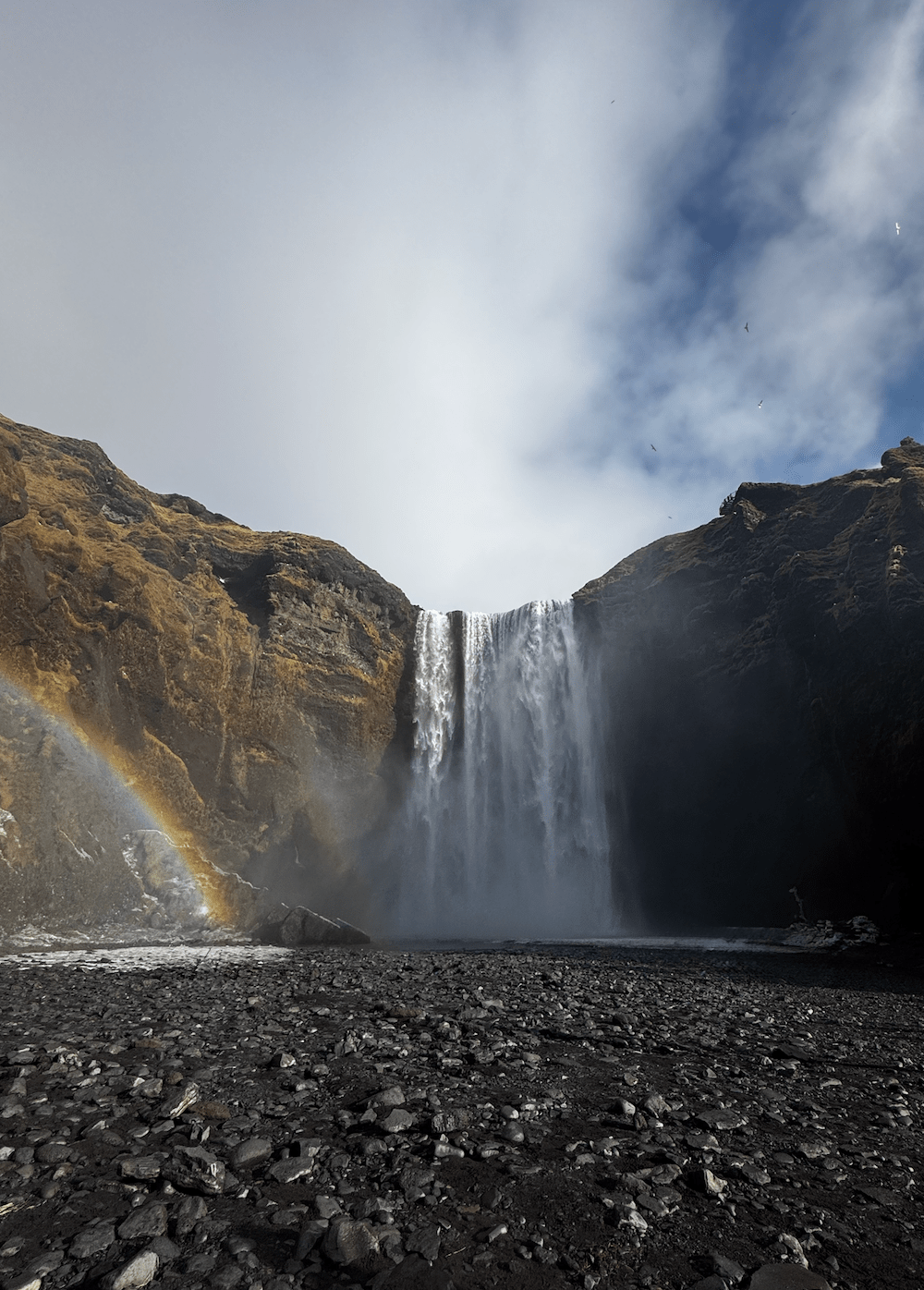
I am not trying to shame the other waterfalls. This is an accepting and loving blog. But Skógafoss is my favorite. Not only did I get to see a waterfall, but there was also a full rainbow stretching across the mist.
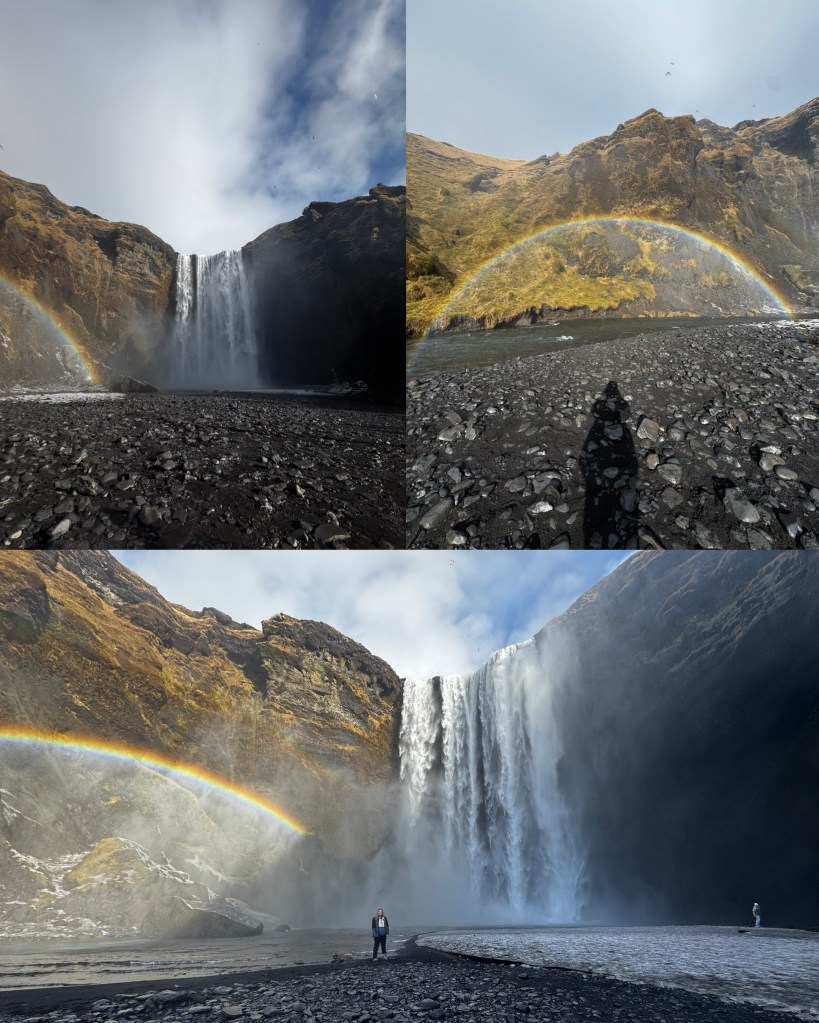
Now, ignoring the exercise torture of climbing 530 steps up the 60-meter cliff, I also got to enjoy the many smaller waterfalls feeding into Skógafoss. My group made it about 1.5 kilometers into what is actually a 25-kilometer hiking trail. If anyone is curious, you can run down 44 flights of stairs in about three minutes.
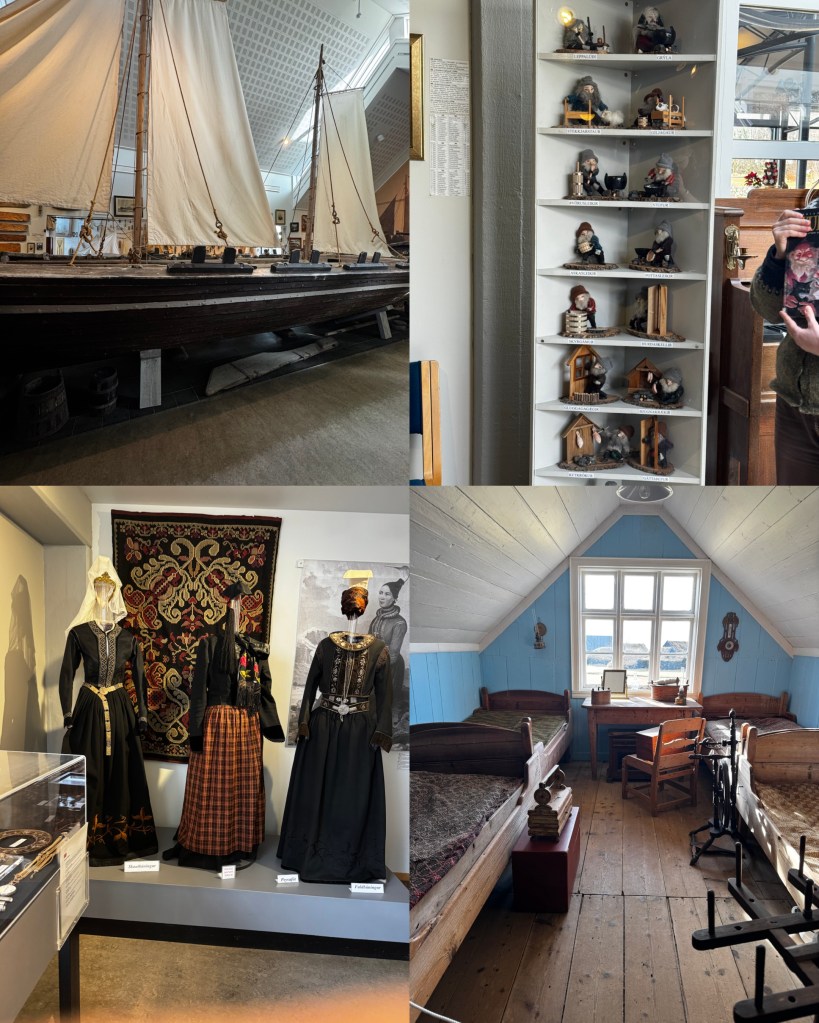
Next on our schedule was the Skógar Museum, also known as the Folk Museum. Here they display the entire collection of Þórður Tómasson. This includes a full fishing boat, fishing tools, replicas, books, clothing, farm equipment, natural history pieces, including a two-headed lamb, textile collections, and numerous paintings.
I was told many stories and learned a lot of information, so imagine yourself walking through the museum with me:
- Icelandic people used to make shoes out of fish skin. It was inexpensive and allowed them to use every part of the fish. Women would often knit the soles of the shoes. Interestingly, women sometimes gifted these knitted soles to boys or men they liked. So fish skin shoes were actually a form of Icelandic flirting. That is a form of flirting even an engineer can understand.
- Women historically had several types of dresses. The dresses were often hand-sewn and usually black because of the limited natural dyes available in Iceland. However, nicer dresses sometimes had embroidered designs along the bottom. If you wanted color in those designs, you had to find or import dye. In order for the dye to stay in the thread, it had to soak in both dye and urine for about 65 weeks. I have several concerns about this process, but they do not pay me to ask questions.
- A woman’s social status was often shown by a small cylinder attached to her headdress or belt. Each generation might add pieces to the belt, so wealthier women had very long metal belts. You could also judge status by the quality of a woman’s saddle. As Ólöf put it while pointing to one saddle, “That right there is a Porsche.”
- Icelandic Christmas folklore includes thirteen trolls known as the Yule Lads. I highly recommend looking up their mother, Grýla. She is a lovely woman who absolutely deserves a modeling career. Her job is to visit farms and collect naughty children so she can cook them in a stew. Based on her appearance, you would never expect that. (Please look her up so you understand my sarcasm)
- Each of the thirteen trolls has a different mischievous behavior. My favorites are the hallway whisperer, the door slammer, and the window peeper.
- Ólöf also told us a story about how modern archaeologists had trouble identifying evidence of seers. Seers were wealthy women believed to have visions or insight into the future. Archaeologists eventually realized they had been overlooking an important clue. Some women were buried with staffs that looked similar to cooking sticks. At first, researchers assumed they were just ordinary household tools. Later they discovered that some staffs were made differently and actually symbolized seers. If only the seers could have predicted that misunderstanding.
- Early Icelandic homes often had one large room where several people slept in the same bed, sometimes three or four at a time. You might wonder about privacy. Icelanders solved this with a different social rule. If the communal lamp was on, work was expected. If the lamp was off, everyone in the house became blind, deaf, and silent. If something was not spoken about, then it was not happening. For example, if a woman were clearly pregnant but never said she was pregnant, then technically she was not pregnant. As we all know, it is safest to never assume someone is pregnant.
- This next story is less of a historical fact and more of a funny quote from Ólöf’s daughter. A common phrase in Iceland is “Oh Christ on a Cross.” But her daughter once said, “Oh Jesus on a Stick.” Honestly, the meaning still works.
After the folk museum, we visited the modern history section, where we saw cars, boats, phones, airplanes, and other technology from Iceland’s more recent past.
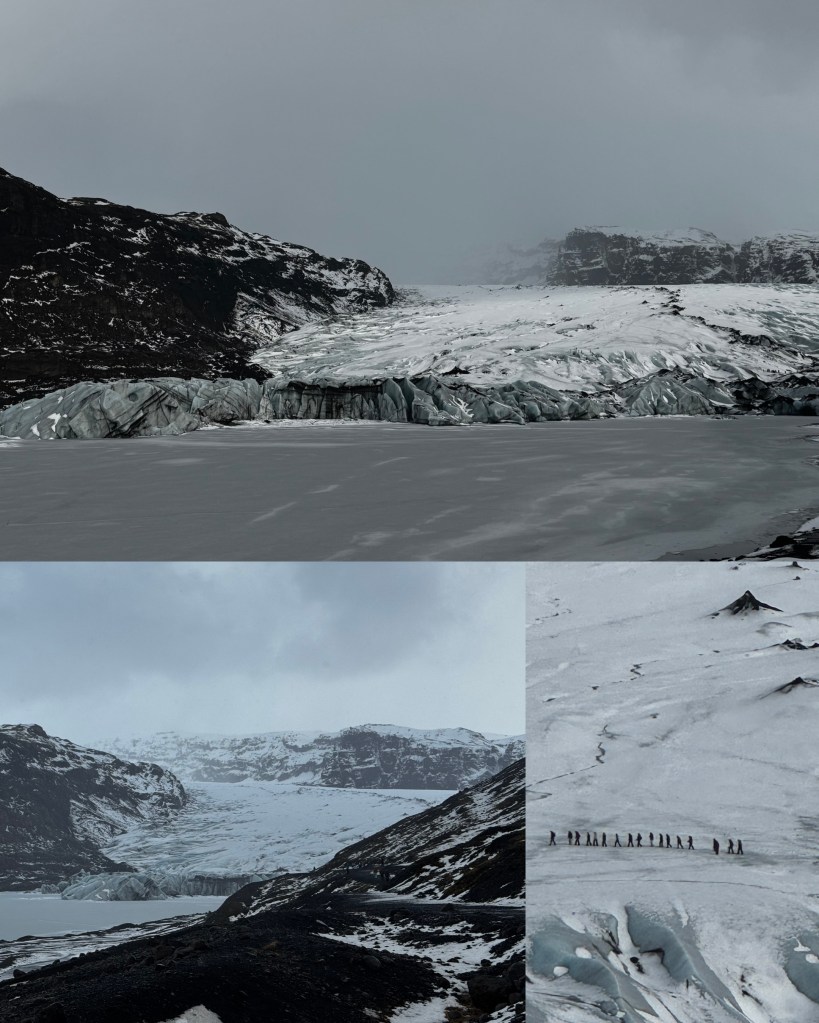
Our next major stop was Sólheimajökull glacier. Sólheimajökull roughly means “home of the sun glacier.” The glacier faces the sun and often reflects a beautiful teal blue color. Unfortunately it is constantly receding because of rising temperatures. It has retreated almost one kilometer since the year 2000. Evidence of this retreat can be seen in the large glacier lake at its base and in chunks of glacier ice still embedded in the surrounding mountains.
We stopped at the viewing platform, but some adventurous strangers continued climbing the glacier using ice axes, crampons, helmets, and a level of courage I do not possess. The warning signs listed risks including avalanches, collapses, floods, quicksand, and several other exciting possibilities. But hey, embrace your inner penguin, brave strangers.
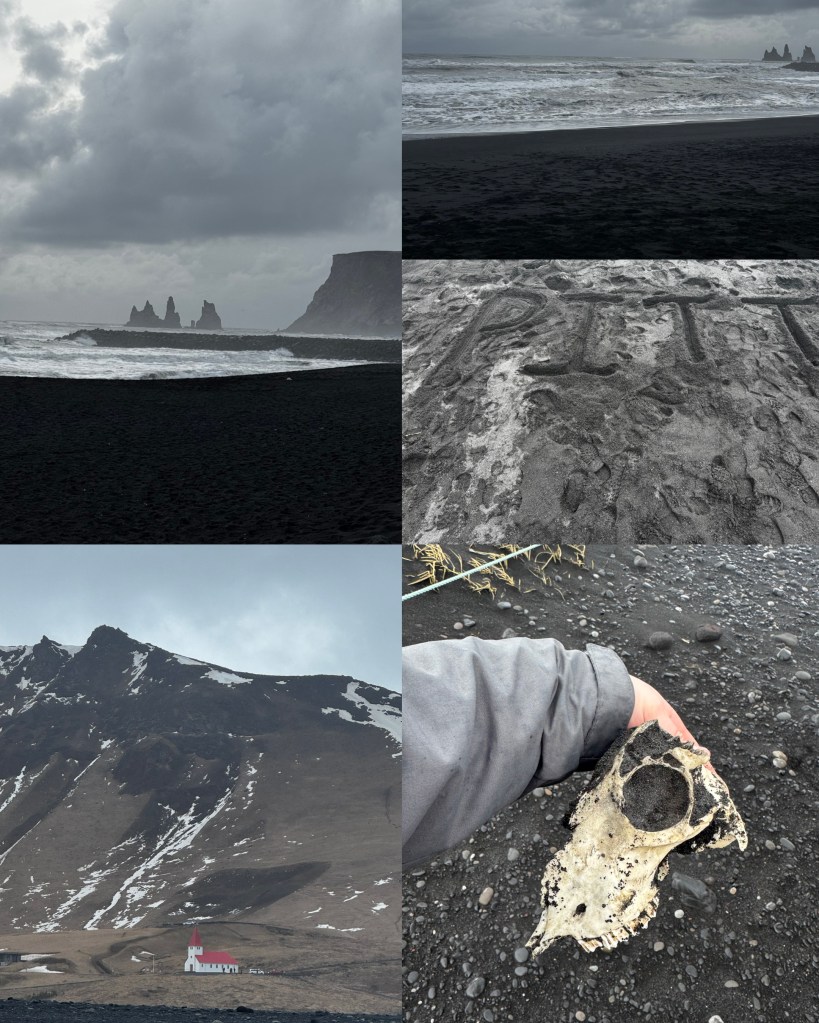
Our last stop was technically just a food break, but we also got to see the famous black sand beaches. One thing visitors are warned about is that the waves here are extremely dangerous. The currents are strong and waves can rush much farther up the beach than expected. One moment you are standing safely, and the next moment the ocean decides you belong to it. Because of that, many of us kept running away from the little waves creeping up the sand because they clearly looked like traps.
If you are curious, black sand beaches are basically regular sand beaches going through a goth phase. You can still build sandcastles, write cheesy messages in the sand, and freeze your hands in the cold sand. Maybe skip that last one.
This blog entry was a long one, so thank you if you made it this far. We are still searching for the northern lights, so hopefully I will return with some glowing green sky stories soon.
Takk fyrir að lesa! (Thanks for reading!)
 Swanson School of Engineering