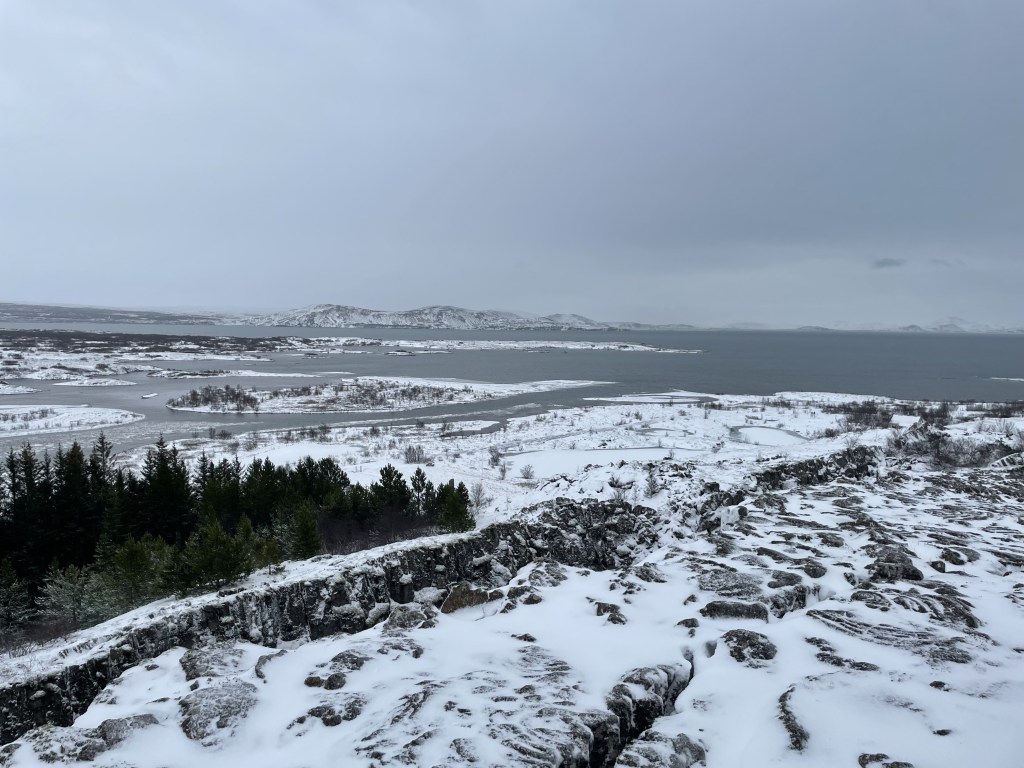
Today, we explored the wonders of Thingvellir National Park. Besides the historical significance, the park is a large valley with a lake flanked by mountains. The valley finds itself along the fault lines of the North American and Eurasia tectonic plates that slowly grow apart each year. This has the effect of deepening the lake each year as well as disturbing the grounds, which can result in fissure eruptions in dramatic cases. This change in environment means that what we saw today was not what the original member of the Icelandic parliament saw a millennium ago. The valley is where the Alþingi was held. This was Iceland’s earliest governmental structure, where each chieftain spread throughout the nation would meet once a year to create laws, handout punishments, and settle disputes. The valley proved the perfect setting as the chieftains had there housing in a pass and the freemen in the open planes below. The pass allowed for a single speaker’s voice to be carried a long distance within to be herd by all of the chieftains. Speech/persuasion was arguably the most important skill for a chieftain to have as they had no formal force to enforce the laws created. It fully revolved around their supporters’ willingness to cooperate and support their decisions. The significance is from how the Alþingi operated. Any freeman could voice his propositions or defend himself in the case of judgement. The common man having a voice in governance gave a greater perspective. This was almost unheard of for the time as Europe was largely dominated by monarchies with the wealth and political gap being drastic. There yearly meeting in the valley helped form Iceland’s identity as it incorporated a diversity of ideas and wasn’t exclusively restricted to the highest class. Being able to get a glimpse into the past from the geography was a great experience in grounding the country’s deep history into a visual story.
- Comment
- Reblog
-
Subscribe
Subscribed
Have a WordPress.com account? Log in now.

