The day started at the Cold War Museum, which was very informative and taught me about the impact the Cold War had on Prague. In the museum, we were able to go down into an old underground bunker, and it was fascinating to see the layout and placement of the filtration systems throughout the space.
From there, we went to the Škoda Auto museum and toured part of the factory. My expectations and prior image of a factory assembly line were completely surpassed during the visit. The use of both robots and workers made the manufacturing process seamless, as they worked together to ensure reliable and consistent vehicle production. We learned that roughly 440 cars are produced during each 8-hour shift, which really put into perspective the demand for cars throughout Europe, something I had never previously considered. The industrial engineering aspect of the assembly line was apparent and ensured constant movement at a speed where multiple teams could work on the same car and add components accordingly. Additionally, there were systems in place to identify and fix problems as quickly as possible to avoid slowing production.
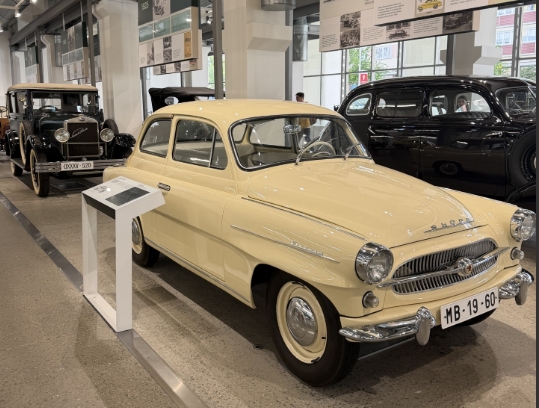
The museum tour also displayed the evolution of Škoda from producing bicycles to automobiles before eventually being bought by Volkswagen (my favorite one, the Škoda Octavia is shown above). It was interesting to learn how vehicles were designed around the buyer’s needs, which is still true today but now with a greater focus on accessibility, technology, and safety.

