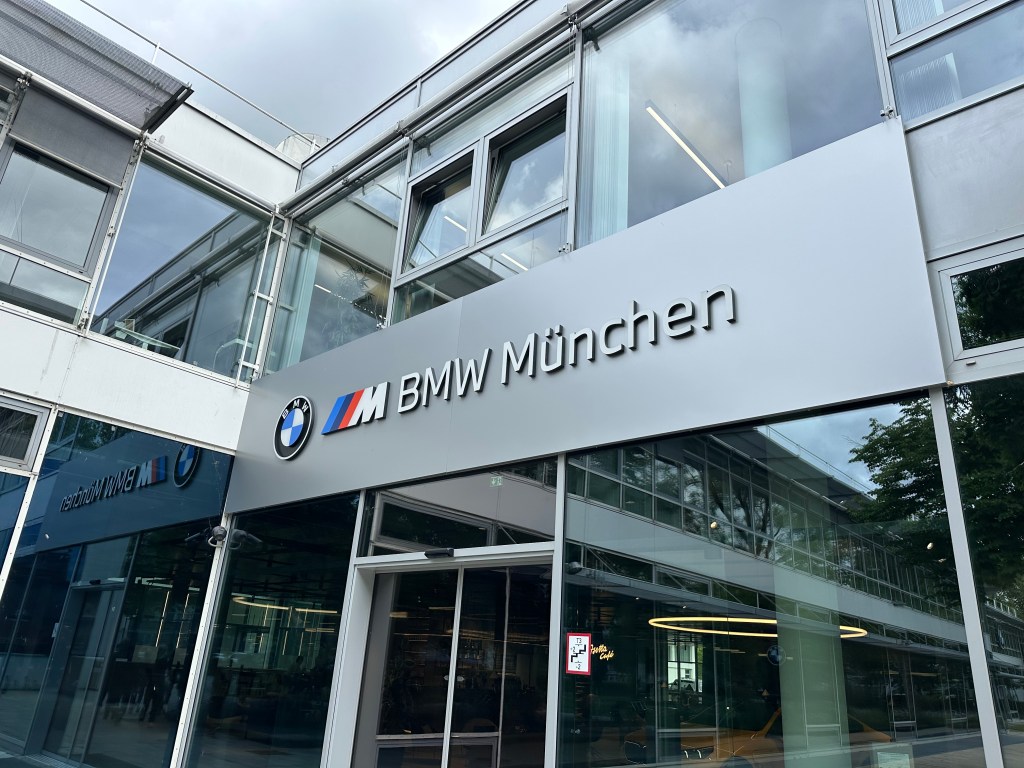
Today, our group visited BMW München (BMW Munich), where we saw the showroom and service area, and later I also visited the BMW Museum. As a BMW fan, it was meaningful to see the brand in its home city, but what stood out to me most was how this visit connected to the larger changes happening in the automotive industry.
At the dealership, the showroom showed a clear image of BMW’s brand identity. The space felt modern, professional, and focused on design, performance, and quality. The visit also connected directly to one of our class projects at HM. Our project focuses on how BMW can attract more young customers in the age of electrification, both for service and for choosing the BMW brand in the future. Before this project, I mostly thought of dealerships as places where people buy cars or get repairs. After the visit, I started to see dealerships as part of a larger customer relationship, especially as cars become more electric and more digital.
One point that stood out to me was that EVs generally require less maintenance than traditional gasoline vehicles. We did not study the technical service differences in detail during the visit, but this idea made me think about how dealerships may need to change. If customers come in less often for regular maintenance, dealerships need to provide value in other ways. Based on what I saw today, this could include making service more convenient, creating a more modern and comfortable dealership space, and designing the customer experience in a way that feels more appealing to younger people. For younger customers, the dealership may need to feel less like a traditional repair place and more like a clean, modern, and welcoming part of the ownership experience.
The BMW Museum added another layer to this reflection. It showed BMW’s long history in engineering, performance, and design. Seeing that history made me understand why German automakers have such a strong reputation. At the same time, it also made the challenge of electrification feel more real. Traditional automakers have a strong foundation, but the industry is changing quickly, and past success does not automatically guarantee future success.
This reminded me of one of our HM classes, where a professor discussed the growth of China’s EV industry. That discussion showed me that the global automotive market is shifting. Chinese EV companies are now important competitors, especially in areas such as manufacturing speed, battery development, digital features, and customer adoption. However, I do not see this as a simple story of one country being ahead and others falling behind. Other automakers, including German and American companies, are also responding in their own ways.
What interested me most is that each country seems to approach electrification differently. China’s EV market feels fast-moving and highly competitive, with quick adoption of new technology. Germany has a long tradition of automotive engineering, premium brands, and careful attention to quality. From my experience studying in the United States, the EV transition often feels slower, partly because of infrastructure, driving distance, consumer habits, and market conditions. These differences helped me realize that electrification is a global trend, but it does not look the same everywhere.
Overall, visiting the dealership and the BMW Museum helped me see the EV transition as more than just a change from gasoline engines to electric motors. It also affects dealerships, customer expectations, brand loyalty, software, service, and global competition. As a mechanical engineering student interested in the automotive industry, this experience helped me connect classroom discussions with real companies and real changes happening in the world.

