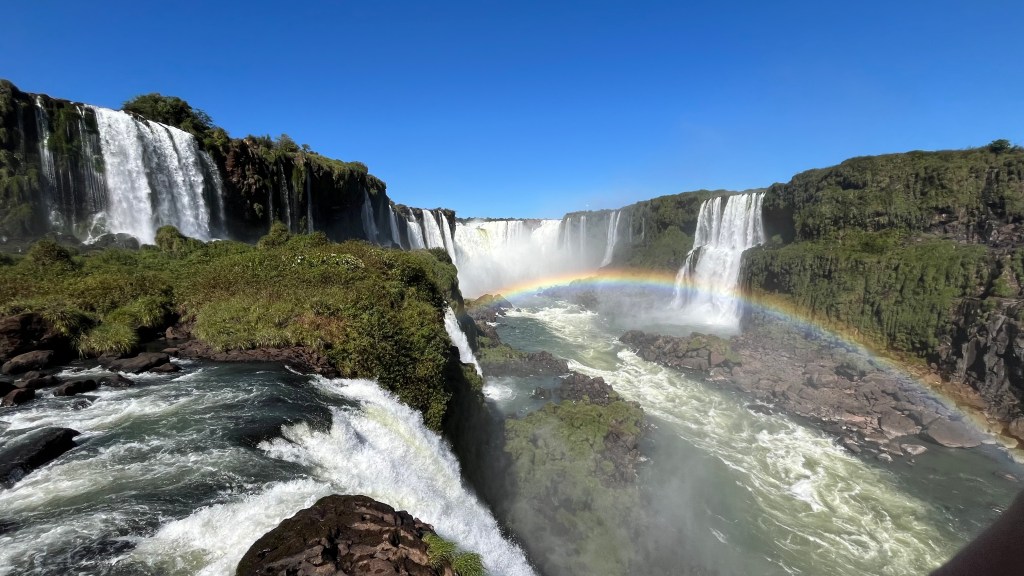
During our visit to Foz do Iguacu, we got to experience a mixture of beautiful sights and awe-inspiring infrastructure. One of our first visits was to the famous Iguazu falls. When we went, there hadn’t been a lot of rain recently, so the Iguacu??? River had a relatively low flow. As a result, we hardly got wet at all when viewing the falls from the wooden platforms. Compared to Niagara Falls, I thought the Iguazu Falls were prettier because the surroundings were mostly dense forest and vegetation compared to the heavily built-up environment surrounding Niagara. There were also a lot more waterfalls compared to the singular, gigantic horseshoe at Niagara. After observing the falls, we visited Parque das Aves, an aviary within a less than five minute bus ride from Iguazu falls. There, you walk through different cages that are integrated into the forest to observe many different tropical birds including Toucans and flamingoes which we learned can die of fear if they get scared. The next day we went to the Itaipu dam which is one of the largest hydroelectric power plants in the world. By annual energy production, the Itaipu dam frequently ranks near the top and has held the number one spot in past years due to the large instantaneous power output of the dam coupled with the Parana River’s consistently high flow from rainfall in the Amazon Rainforest upstream. The sheer scale of the dam was incredible; we drove along the top of it and also got to see it up close from below. We got to go inside and see the rotor shaft of one of the massive, 700MW turbines spinning. The dam is shared between Paraguay and Brazil and sits on the border between the two nations. Half of the dam produces power in 50Hz for Paraguay and the other half in 60Hz for Brazil, and the two sides are allowed to buy and sell electricity between each other. The dam basically supplies the entire nation of Paraguay with electricity (about 89% of Paraguay’s electricity comes from their half of the Itaipu dam) and it supplies a decent chunk (about 9%) of Brazil’s electricity (a lot is sent to Sao Paulo via massive +/- 600kV HVDC and 800kV AC transmission lines. The city of Foz do Iguacu was larger and more tourist centric compared to Sao Leopoldo and Porto Alegre, so there were better opportunities to explore and learn about the culture of Brazil and the adjacent nations of Argentina and Paraguay; people often spoke Portuguese, Spanish, and English.
- Comment
- Reblog
-
Subscribe
Subscribed
Have a WordPress.com account? Log in now.

