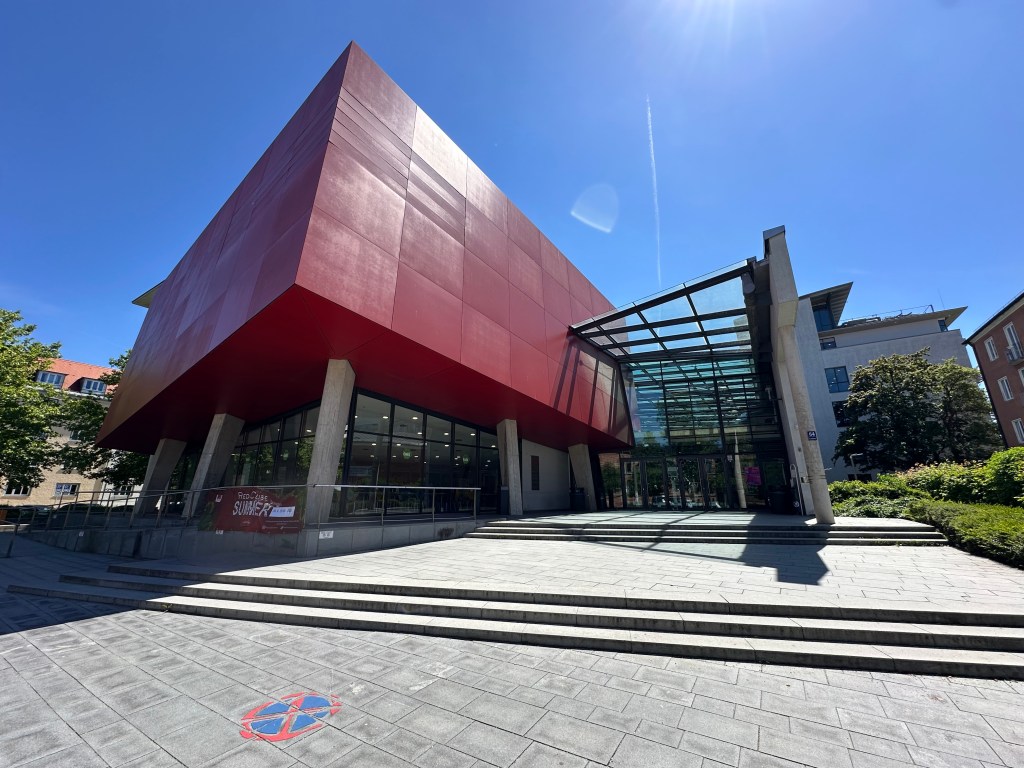
During the program, we had many opportunities to work with German students, which gave me insight into how American and German university systems can differ. Before coming to Munich, I mostly understood engineering education through my experience at Pitt. Studying at Hochschule München, or Munich University of Applied Sciences, helped me see a different way of connecting school with work experience.
One thing that stood out to me was how practice-oriented HM felt. Many of the students we met were working for a company while attending school. Because of that, their schedules seemed different from what I am used to at Pitt. Some classes were relatively long, often two to three hours, but students might only take a few classes at a time. At Pitt, many students take 12 to 18 credits per semester and usually complete internships during breaks or co-op rotations. I do not think one system is simply better than the other, but they clearly emphasize different things.
One of the most memorable classes I had was Lean Production. In this class, we worked in teams to build a small production process. Each team decided how many workstations to use, how to arrange the layout, and how to divide tasks among team members. After each run, we discussed what could be improved, changed our process, and prepared for the next round.
Even though I had never studied lean production before, this hands-on activity helped me understand the concept quickly. Instead of only learning about efficiency, bottlenecks, and process improvement through a lecture, we experienced them directly. When our process was too slow or unbalanced, we could immediately see where the problem was. When we changed the layout or reassigned tasks, we could test whether the process improved. This helped me connect the concept with practice in a very intuitive way.
Working with German students also made this experience more meaningful. Many of them seemed comfortable applying classroom ideas to practical problems. Their approach felt very hands-on and problem-solving oriented. This reminded me that engineering is not only about learning theories or solving equations. It is also about testing ideas, working with a team, and improving a system step by step.
One thing I will probably remember most from HM is how often learning happened through actually doing something. My experience at Pitt has given me a strong academic foundation, but this program gave me a chance to see how classroom ideas can be applied in a much more hands-on way. It was interesting to experience a different approach and think about how both styles of learning can complement each other.

